
You've seen them — grids of letters, arrows, and Roman numerals plastered across guitar forums, songwriting tutorials, and music theory sites. A chord progression chart looks like a cheat code that everyone else already knows how to read. If you've stared at one thinking "what do these numbers even mean?", this guide is for you.
Here's the truth: chord progression charts are not music theory gatekeeping. They're a shortcut — a way to see, at a glance, which chords work together and why. Once you understand three things (Roman numerals, the Nashville number system, and the circle of fifths), you can read any chord progression chart in under a minute — and more importantly, use it to write songs.
We'll start from zero, explain every symbol, and show real examples along the way. No conservatory training required.
What Is a Chord Progression, Really?
A chord progression is simply a sequence of chords played one after another. That's it. Strum a C chord, then an F chord, then a G chord — you just played a C–F–G progression. It's the emotional backbone of your song: the same melody sung over different chord progressions can sound hopeful, melancholy, tense, or resolved.
Every key contains seven chords — one built on each note of the scale. In C major, those chords are: C, Dm, Em, F, G, Am, and Bdim. They follow a fixed pattern that's the same in every major key:
That pattern — major, minor, minor, major, major, minor, diminished — is identical in every key. In G major it's G–Am–Bm–C–D–Em–F♯dim. In D major it's D–Em–F♯m–G–A–Bm–C♯dim. Same DNA, different starting note. This is why charts use numbers instead of letter names: a number tells you the function of the chord, not just its name.
Key insight
A chord progression is a story arc told in chords. The I chord is "home." The V chord creates tension that wants to go back home. The vi chord adds emotional depth. Understanding these roles is more useful than memorizing individual chord names — because the roles stay the same in every key.
Why Chord Progression Charts Exist (And Why You Want One)
A chord progression chart solves one problem: you don't want to reinvent music theory every time you write a song. Thousands of songs use the same handful of progressions — not because songwriters are lazy, but because certain chord movements feel satisfying to the human ear. A chart organizes these movements visually so you can:
- Find chord combinations that work in any key without trial and error
- Understand why a progression feels the way it does — is it the I-to-IV movement creating lift, or the V-to-vi deceptive cadence creating surprise?
- Transpose songs instantly — read the numbers, not the letters, and you can play the same progression in any key
- Communicate with other musicians — "it's a I–V–vi–IV in G" is faster and clearer than "play G, then D, then Em, then C"
The two most common chart formats — Roman numeral charts and Nashville number charts — do the same thing in slightly different ways. Both are worth knowing.
How to Read the Chart: Roman Numerals, Nashville Numbers, and Letter Names
There are three ways the same progression gets written down. Here's how to read all of them:
Roman Numerals (the universal language)
Each chord in a key gets a Roman numeral based on its position in the scale:
| Scale degree | Roman numeral | Chord quality | In C major |
|---|---|---|---|
| 1st (tonic) | I | Major | C |
| 2nd (supertonic) | ii | Minor | Dm |
| 3rd (mediant) | iii | Minor | Em |
| 4th (subdominant) | IV | Major | F |
| 5th (dominant) | V | Major | G |
| 6th (submediant) | vi | Minor | Am |
| 7th (leading tone) | vii° | Diminished | Bdim |
Uppercase = major, lowercase = minor. So I–V–vi–IV means "play the 1 chord (major), the 5 chord (major), the 6 chord (minor), then the 4 chord (major)." In C major, that's C–G–Am–F. Same numbers in G major: G–D–Em–C. The numbers never change — only the starting note does.
Nashville Numbers (the session musician's shorthand)
Nashville numbers replace Roman numerals with Arabic digits: 1, 2, 3, 4, 5, 6, 7. A dash after the number means minor (2- = ii, 3- = iii, 6- = vi). A degree symbol means diminished (7° = vii°). A I–V–vi–IV in Nashville reads: 1 5 6- 4. It's faster to write than Roman numerals and looks less academic — which is exactly why Nashville session players invented it.
Letter-Name Charts (the guitar forum standard)
The simplest format: just the chord names. C – G – Am – F. Easy to read but locked to one key. If your singer needs the song a step lower, every chord name changes. That's why Roman and Nashville notation exist — they're key-agnostic.
Which one should you learn?
Start with Roman numerals. They're the lingua franca of music theory and appear in every chord progression chart you'll find online. Nashville numbers are a bonus — learn them if you collaborate with session players or write in country/pop genres.
The Popular Progressions Every Songwriter Should Know
These popular chord progressions — including easy guitar chord progressions for beginners — appear in hundreds, sometimes thousands, of songs. They're not cliches; they're proven emotional frameworks. Learn these five first:
I–V–vi–IV (the "Axis" progression)
The most used progression in modern pop. "Let It Be," "Don't Stop Believin'," "With or Without You," and literally hundreds more. It works because the I-to-V creates forward motion, the V-to-vi is a surprise (minor instead of major), and the vi-to-IV lifts back toward home.
In C major: C – G – Am – F
I–IV–V (the blues/rock backbone)
Three chords, endless possibilities. "Twist and Shout," "La Bamba," "Wild Thing." The I–IV–V is the foundation of blues, rock, and country. It's the first progression most guitarists learn — and it still powers stadium anthems.
In C major: C – F – G
vi–IV–I–V (the "sad but hopeful" progression)
Start on the minor vi instead of the major I, and the whole progression feels more emotional. "Someone Like You" by Adele, "Numb" by Linkin Park, "Apologize" by OneRepublic. This is the I–V–vi–IV in a different order — same four chords, completely different emotional direction.
In C major: Am – F – C – G
ii–V–I (the jazz standard)
The most important progression in jazz. It appears at the end of almost every jazz standard phrase. The ii sets up tension, the V intensifies it, and the I resolves it. Even if you don't play jazz, understanding ii–V–I teaches you the core principle of chord function: chords want to move in predictable directions.
In C major: Dm – G – C
I–IV–vi–V (the "four chord song" variation)
Swap the positions of vi and V from the Axis progression and you get a brighter, more anthemic feel. "Hey Ya" by Outkast, "I'm Yours" by Jason Mraz. The V at the end creates forward momentum that loops seamlessly back to the I.
In C major: C – F – Am – G
Guitar Strumming Patterns: Where Rhythm Meets Chords
A guitar chord progression chart tells you which chords to play. But a chord movement chart only gives you the harmony — the rhythm, how you play them, is what makes the same four chords sound like a reggae song in one arrangement and a folk ballad in another. This is where guitar strumming patterns come in.
Three Essential Strumming Patterns
| Pattern | Notation | Feel | Works best with |
|---|---|---|---|
| Down-down-up-up-down-up | D D U U D U | Driving, folk-rock | I–V–vi–IV, I–IV–V |
| Down-down-down-down (4 beats) | D D D D | Steady, anthemic | vi–IV–I–V |
| Bass-strum (alternating) | Bass note then full strum | Country, ballad | I–IV–V, ii–V–I |
The rule of thumb: match the strumming energy to the progression's emotional arc. A I–V–vi–IV feels natural with flowing eighth-note strums (D D U U D U). A I–IV–V rocks harder with driving quarter notes. Start simple — four steady down-strums per bar — and add complexity as the song demands it.
These half notes give a spacious, ballad-like feel — long strums on each chord. Now imagine the same progression played as rapid eighth-note down-up strums. Same four chords, same order — completely different song. The chord progression chart gives you the framework; your strumming hand gives it life.
The Circle of Fifths: Your Chord Movement Map
A circle of fifths chord progression chains chords by fifths — each chord resolves naturally to the next. The circle of fifths itself is a diagram that arranges all 12 keys: moving clockwise, each key is a fifth above the previous one (C → G → D → A → E → B → F♯ → C♯). Counterclockwise, each key is a fifth below (C → F → B♭ → E♭ → A♭ → D♭ → G♭ → C♭). But it's not just a key-reference tool — it's also a chord movement map.
Here's why this matters for chord progressions:
- Chords want to move counterclockwise. The most satisfying chord changes go to the left on the circle. In C major, that's C → F (IV) or C → Bdim (vii°) — both counterclockwise movements. The V → I resolution? G is directly clockwise from C on the circle — which means I → V goes counterclockwise. This single insight explains why 90% of chord changes in popular music feel "right."
- Circle of fifths progressions are a genre in themselves. The sequence C → F → Bdim → Em → Am → Dm → G → C moves counterclockwise through the entire circle. It's the harmonic engine of baroque music, jazz turnarounds, and "Fly Me to the Moon."
- Adjacent chords on the circle share four of seven notes. C major and G major share C, D, E, G — that's why C → G and G → C sound smooth. Adjacent = consonant.
Every chord in this example is one counterclockwise step from the previous one. It sounds inevitable — like gravity pulling each chord toward the next. That's the circle of fifths at work.
For a complete deep dive into how the circle works and how to use it for chord selection, see our dedicated guide (coming soon). For now, the one thing to remember: when in doubt about which chord comes next, go counterclockwise on the circle of fifths.
How to Actually Use Charts When Writing a Song
Here's a real workflow — not theory, but what you do when you sit down to write:
- Pick a key. C major if you're on piano or guitar in standard tuning. G major if you want brighter guitar voicings. D major if you're writing for a female vocal and want room to move up.
- Pick a progression from the chart. Start with I–V–vi–IV or I–IV–V. They work because they always work. Don't try to be original at the chord level — be original with melody, lyrics, rhythm, and arrangement.
- Map the Roman numerals to your key. I–V–vi–IV in C major = C–G–Am–F. Write those chords above your lyric sheet or DAW timeline.
- Add a strumming pattern or rhythmic feel. Four down-strums per bar = anthemic. D-D-U-U-D-U = folk-pop. Fingerpicking = ballad.
- Write the melody on top. The chords are the floor. The melody walks on it. Hum over the progression until a tune sticks — record everything, even the bad takes.
- Vary one thing at a time. Verse = I–V–vi–IV. Chorus = same progression with a different strumming pattern, or keep the strumming and swap one chord. Small changes create structure without overcomplicating.
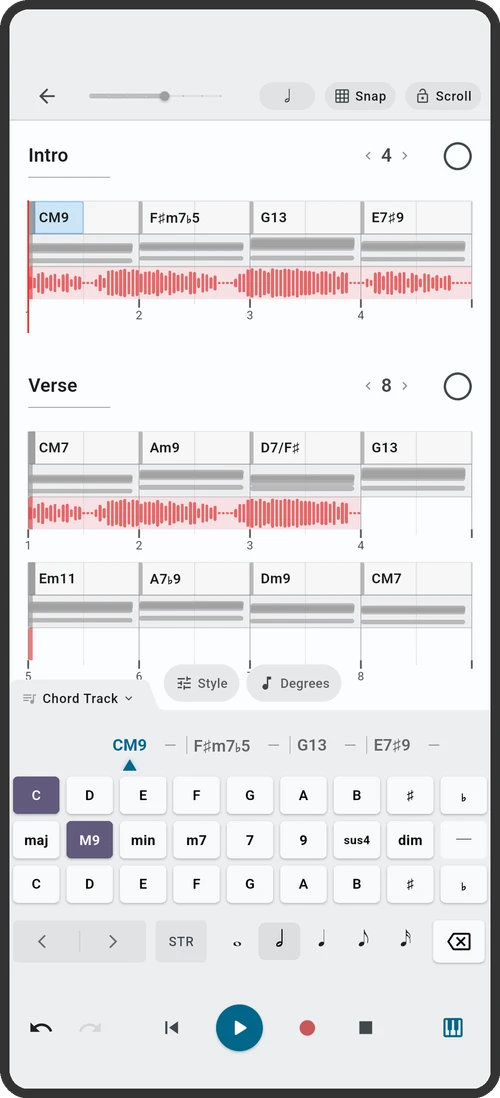
Write songs, not notation
Pick a progression from the chart, set your key, and start recording immediately. Faso handles the chords — you handle the song. No notation, no theory required.
Quick-Reference Cheat Sheet
- Major key chord pattern (every key): I ii iii IV V vi vii° (major, minor, minor, major, major, minor, diminished)
- I–V–vi–IV: The Axis progression — C–G–Am–F in C major. Hundreds of pop/rock songs.
- I–IV–V: Blues/rock backbone — C–F–G in C major. Three chords, infinite songs.
- vi–IV–I–V: Sad-hopeful — Am–F–C–G in C major. Emotional ballads.
- ii–V–I: Jazz standard — Dm–G–C in C major. Teaches chord function.
- Nashville numbers: 1 = I, 2- = ii, 3- = iii, 4 = IV, 5 = V, 6- = vi, 7° = vii°
- Circle of fifths shortcut: chords want to move counterclockwise. When stuck, go one step left on the circle.
You now know how to read any chord progression chart you'll encounter — Roman numerals, Nashville numbers, or letter names. The five progressions above are the foundation of thousands of songs across every genre. Pick one, pick a key, and start strumming. The theory is here when you need it — but the song won't write itself.