Every guitarist remembers the moment: you pick up the instrument, put your fingers on the fretboard, and make a shape. You strum. It rings out. That single chord shape — three or four fingers in a specific arrangement — is the foundation of everything you'll play from this point forward. And the faster you build a mental library of guitar chord shapes, the faster you'll play real songs.
This guide covers the essential shapes every beginner needs, how to read a guitar finger chart, the barre chord variations that unlock the entire fretboard, and — most importantly — how Faso's real-time fretboard view makes learning and jamming with chords dramatically easier. Let's start with the shapes themselves.
What Are Chord Shapes, Really?
A chord shape is a specific arrangement of your fingers on the fretboard that produces a chord when strummed. The shape is movable: the same finger pattern shifted up or down the neck produces the same chord type in a different key. An E major shape moved up one fret becomes F major. Up two frets becomes F♯ major. The shape stays the same; the root note changes.
This is the most important concept in guitar playing: you're not memorizing hundreds of individual chords. You're memorizing a handful of shapes and sliding them around the neck. Once you internalize the five open-position shapes below and understand how barre chords work, you can play any major or minor chord on the guitar.
The Five Essential Open Chord Shapes
These five shapes, in standard tuning, cover the vast majority of beginner and intermediate songs. All guitar chords in standard tuning are built from movable versions of these patterns:
| Chord | Strings (low E to high e) | Fingers | Key tip |
|---|---|---|---|
| C major | x-3-2-0-1-0 | Ring-3, Middle-2, Index-1 | Index on 1st fret B string anchors the shape |
| A major | x-0-2-2-2-0 | Three fingers on 2nd fret D-G-B | Keep fingers cramped inside one fret — tightest shape |
| G major | 3-2-0-0-0-3 | Middle-2 (A), Ring-3 (low E), Pinky-3 (high e) | Stretch between middle and ring is the challenge here |
| E major | 0-2-2-1-0-0 | Middle-2 (A), Ring-2 (D), Index-1 (G) | Foundation of the E-shape barre chord — most important movable shape |
| D major | x-x-0-2-3-2 | Index-2 (G), Ring-3 (B), Middle-2 (high e) | Smallest shape — only four strings, great for fast changes |
Practice these five shapes until you can form each one without looking. The goal isn't speed — it's accuracy. Every string should ring cleanly, with no buzzing or muting. If a note buzzes, adjust your finger position, not your pressure. Pressing harder doesn't fix a finger that's in the wrong place.
How to Read a Guitar Finger Chart
A guitar finger chart — also called a chord diagram — is the standard way guitar chords with fingers are shown in books, apps, and online lessons. Here's how to read one:
- Vertical lines = strings. Left line is low E (thickest string), right line is high e (thinnest).
- Horizontal lines = frets. The top thick line is the nut. The next line down is the 1st fret, then 2nd, etc.
- Dots on the lines = where to place your fingers. A dot on the 2nd line from the left at the 1st fret = index finger on the A string, 1st fret.
- Numbers inside the dots = which finger to use. 1=index, 2=middle, 3=ring, 4=pinky.
- X above a string = don't play that string. O above a string = play it open (no finger).
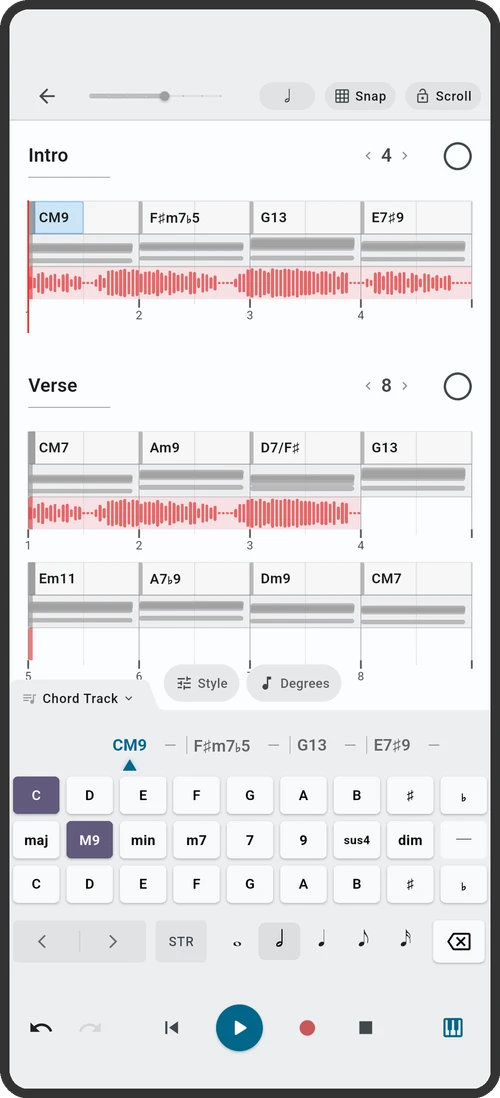
Faso displays chord diagrams in real time — as your chord chart scrolls during playback, the fretboard view updates to show you exactly where your fingers go for the next chord. This is the feature that transforms Faso from a chord sheet writer into an interactive practice and jam companion.
Barre Chords and Chord Variations: Beyond the Open Shapes
Once you're comfortable with the five open shapes, the next frontier is barre chords — using your index finger to press down all six strings across a single fret, while your remaining fingers form a chord shape above it. This is physically demanding at first, but it's the skill that gives you access to the entire fretboard.
The two fundamental barre shapes:
| Shape | Based on | Root note on | Example (1st fret) |
|---|---|---|---|
| E-shape barre | E major (open) | 6th string (low E) | F major: 1-3-3-2-1-1 |
| A-shape barre | A major (open) | 5th string (A) | B♭ major: x-1-3-3-3-1 |
There are different ways to play guitar chords beyond these barre shapes. A chord guitar variations include: using a capo to transpose open shapes up the neck, partial barres that only cover 3-4 strings, and shell voicings that omit the 5th for a cleaner sound in band contexts. The chord shape library expands as you explore — but the five open shapes and two barre shapes are the foundation everything else builds on.
Real-Time Fretboard View: How Faso Changes the Game for Jamming
Here's the problem with traditional chord charts: they tell you what chord to play, but not how to play it. A lead sheet says "Cmaj7." If you don't know that shape cold, you pause. The jam stops. The moment dies.
Faso's real-time fretboard display solves this. As your chord chart scrolls during playback, Faso shows you the exact finger positions for each upcoming chord — before the change arrives. You see the shape on the fretboard, your fingers move into position, and you hit the chord on time. This is especially powerful for:
- Jamming along with backing tracks. Faso generates drums, bass, and accompaniment that follow your chord chart. The fretboard view shows you the shapes in sync with playback. You're not reading a static chart — you're following a real-time visual guide that moves with the music.
- Learning new chord shapes. When Faso's chord chart shows a chord you don't know — maybe a Bm7♭5 in a jazz progression — the fretboard view displays exactly where to put your fingers. You learn the shape by playing it, in context, with real music.
- Experimenting with voicings. Faso can show different ways to play guitar chords: open position, barre, or shell voicing. Try them all over the same backing track and hear which one fits the arrangement best.
The jam session advantage
In a jam, you don't have time to look up chord shapes. Faso's fretboard view anticipates the next chord and displays it before the change. Your eyes see the shape, your fingers follow, and the music never stops. This is the difference between practicing chords in isolation and actually playing them in a musical context.
A 10-Minute Chord Shape Practice Routine
- Minutes 0-2: Cycle through the five open shapes — C, A, G, E, D. Strum each once, hold for 4 beats, switch. Focus on clean ringing, no buzz.
- Minutes 2-5: Practice the two hardest transitions: C↔G and G↔D. Use the pivot finger technique — leave one finger anchored between chords when possible.
- Minutes 5-8: Open Faso. Load a I-V-vi-IV progression in C (C–G–Am–F). Turn on the fretboard view. Play along as the chart scrolls — the fretboard shows you each shape before the change.
- Minutes 8-10: Switch Faso to a key you're less comfortable in — try E major or A major. Let the fretboard view guide you through the new shapes. This is how you expand your chord vocabulary without memorizing charts.
Write songs, not notation
Faso's real-time fretboard view shows you exactly where to put your fingers for every chord — synced to playback. Learn new shapes in context, jam along with backing tracks, and never pause to look up a chord again.