Scales have a reputation problem. They're the vegetable on the music plate — everyone says you need them, nobody's excited about them. But here's the thing: guitar scales are not an academic exercise. They're the raw material of every melody, every solo, every riff you've ever loved. The difference between a guitarist who knows guitar scales guitar players actually use and one who doesn't is the difference between guessing which notes will work and knowing.
This guide covers the essential guitar scales every beginner should learn first — C major, A minor pentatonic, and G minor — with practical guidance on how to practice them without it feeling like homework. We'll also look at how Faso's scale view turns the fretboard into a visual map, so you spend less time memorizing patterns and more time making music.
What Are Guitar Scales, Really?
A scale is simply a sequence of notes arranged by pitch — usually seven notes in an octave for major and minor scales, five for pentatonic scales. On guitar, scales become fretboard patterns: a specific sequence of frets and strings that you can slide up and down the neck. Move a C major scale pattern up two frets and you get D major. The pattern stays identical — only the starting position changes.
This is the guitar's superpower: transposition is just moving your hand. A pianist needs to learn different fingerings for every key. A guitarist learns one pattern per scale type and slides it. This is also why learning a few core guitar scales well is more valuable than memorizing dozens poorly. Master three patterns and you can play in any key.
Scales are a map, not the destination
The goal of practicing scales isn't to play scales in your songs. It's to internalize which notes belong in which keys, so when you improvise a solo or write a melody, your fingers naturally find notes that sound right. Scales train your ear-hand connection. Music happens when you stop thinking about the scale and just play.
The C Major Scale: Your First Scale, Step by Step
The c major scale guitar players learn first is the obvious starting point: no sharps, no flats, just the natural notes C-D-E-F-G-A-B-C. On the fretboard, here's the most common one-octave pattern starting from the 3rd fret of the A string:
On the guitar, this translates to a pattern that spans about four frets. The c scale guitar pattern is the foundation — once you can play it cleanly ascending and descending, you can move the same pattern to start on any root note to play other major scales.
How to Practice the C Major Scale
- Play it slow, one note per beat. Use a metronome at 60 BPM. Play C-D-E-F-G-A-B-C ascending, then C-B-A-G-F-E-D-C descending. One note per click.
- Say the note names out loud as you play. This builds the connection between the fretboard position, the note name, and the sound. Your ears, fingers, and brain learn together.
- Play it in different rhythms. Once the even eighth notes are solid, try dotted rhythms (long-short, long-short) and triplets. This prevents your fingers from learning the scale as one rigid muscle-memory sequence.
- Move the pattern. Start on D (5th fret, A string) and play the same finger pattern. You're now playing D major. Same shape, different key. This is the moment the fretboard starts to make sense.
The A Minor Pentatonic Scale: The Blues and Rock Staple
The a minor scale guitar pentatonic is the most-used scale in blues, rock, and pop guitar. "Pentatonic" means five notes — A-C-D-E-G — instead of the usual seven. Those five notes, played over almost any chord progression in A minor or C major, will sound musical. This is the scale that powers solos by B.B. King, Jimmy Page, and Slash.
The A minor pentatonic pattern on guitar starts at the 5th fret of the low E string and spans four frets across all six strings. What makes this scale special: every note works over every chord in a standard blues or rock progression in A minor. You can't hit a wrong note. This is why it's the first scale guitar teachers give to students who want to solo — it builds confidence immediately.
How to Practice the A Minor Pentatonic
- Learn the box pattern. Start at the 5th fret, low E string. Play through all six strings ascending and descending. This is "Position 1" of the pentatonic — the most important box on the entire fretboard.
- Improvise over a backing track. Open Faso, set a I-IV-V blues in A minor, hit play, and solo using only Position 1 notes. Don't plan — just play. The backing track gives you harmonic context; the pentatonic gives you a safety net.
- Bend the G note (3rd string, 5th fret). Push the string up a whole step toward A. This is the signature move of blues guitar. The bend is what makes five notes sound like a lifetime of vocabulary.
G Minor Scale: A Darker, Richer Sound
The g minor scale guitar adds two flats (B♭ and E♭) and immediately darkens the mood. G-A-B♭-C-D-E♭-F-G. This is the natural minor scale — the same pattern as every other minor key, just starting on G. It's the scale behind "Stairway to Heaven," "Hotel California," and countless metal and hard rock riffs.
The G minor scale pattern starts at the 3rd fret of the low E string. If you already know the A minor pentatonic positions, the full G natural minor scale adds two notes to each pentatonic box — the 2nd and the 6th scale degrees. Those two extra notes transform the bluesy, safe sound of the pentatonic into something more melodic and emotionally complex.
Practice G minor the same way as C major: slow, clean, with a metronome, saying note names. Then move the pattern to A minor (5th fret), B minor (7th fret), and E minor (open position + 12th fret). Same shape, different starting point, five new keys.
Guitar Scales to Practice: A Daily Routine
Here are the guitar scales to practice daily — not all at once, but rotating through a focused 10-minute block:
- Day 1: C major, two octaves. Start slow. Focus on clean tone — no buzzing, no muted strings. Alternate picking (down-up-down-up) throughout.
- Day 2: A minor pentatonic, Position 1. Play to a backing track in Faso. Five minutes of the scale pattern, five minutes of improvising within it.
- Day 3: G minor, one octave. Alternating with A minor pentatonic. Compare the two — hear how the two extra notes change the character.
- Day 4: Move C major to D major. Same pattern, start on the 5th fret. Congratulations — you now know two major scales.
- Day 5: Connect pentatonic positions. Learn Position 2 of A minor pentatonic and practice sliding between Position 1 and Position 2. This is the skill that turns box patterns into fretboard fluency.
How Faso's Scale View Makes Practicing Scales Visual
The hardest part of learning guitar scales isn't the finger movements — it's visualizing where the notes are on the fretboard. A scale diagram in a book shows you one static picture. But music moves. The chord changes. The scale that worked over the I chord might need adjusting over the IV.
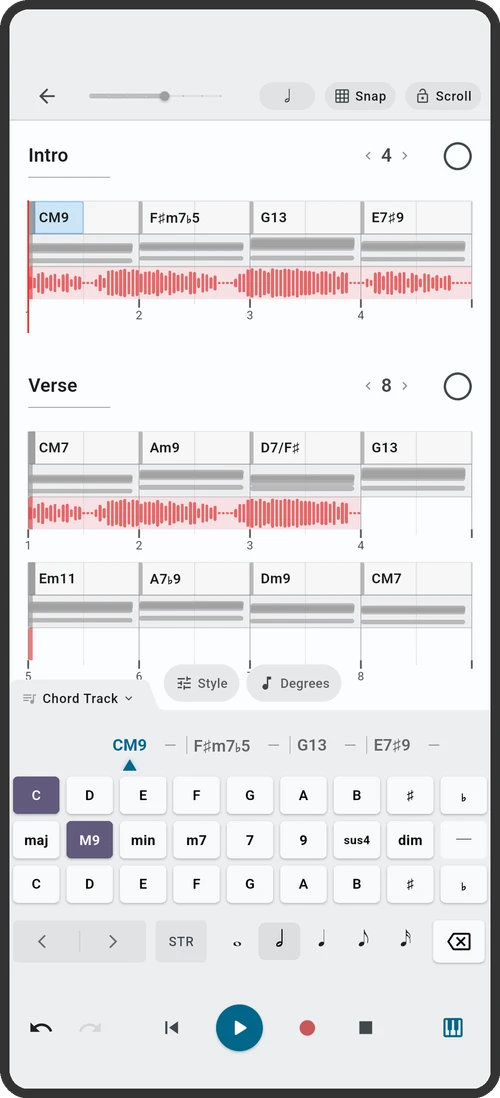
Faso's scale view solves this by showing you the scale notes on a real-time fretboard display that stays in sync with your chord chart. Here's what that means in practice:
- See the scale light up on the fretboard. When Faso's chord chart is playing, the scale view highlights which notes belong to the current scale — in real time, synced to playback. You see where the safe notes are before you play them.
- Switch scales with the chords. As the chord chart moves from C major to A minor, Faso automatically shows you the A minor pentatonic scale positions. You don't stop to figure it out — the visual updates for you.
- Practice scales in musical context. Instead of playing scales in isolation with a metronome, you play them over a full backing track — drums, bass, accompaniment — generated from your chord chart. The scale view shows you the map; the backing track gives you the reason to use it.
This is the difference between practicing scales as an abstract exercise and actually using them in music. Faso turns the fretboard into a visual guide that moves with your song, so you're always one glance away from knowing which notes will sound right.
Write songs, not notation
Faso's scale view lights up the fretboard with the right notes for every chord in your progression — synced to playback. Practice scales in musical context with full backing tracks, and never guess which notes to play again.