You've got a melody in your head. Maybe a lyric fragment. But when you sit down to turn it into a real song, you hit a wall. What chords do I play? What comes next? Does this even make sense musically?
Here's the thing most people don't realize: you don't need to know music theory to write a song. You need a chord progression — a sequence of chords that creates movement and emotion. Once you have that, the rest of the song falls into place around it.
This guide will walk you through writing your first full song from chord progressions — even if you've never studied music theory in your life. We'll cover picking a key, finding chords that work together, structuring sections, and recording a rough demo you can be proud of.
What a Chord Progression Actually Does
A chord progression is just a sequence of chords played one after another. That's it. Think of it as the emotional scaffolding of your song: the same melody sung over different chords can sound hopeful, melancholy, or tense.
The most famous example: I–V–vi–IV. In the key of C major, that's C – G – Am – F. This single progression has powered hundreds of hits from "Let It Be" to "Someone Like You" to "Don't Stop Believin'." Same four chords, completely different songs.
Key insight: the chord progression comes first. It's easier to build a melody on top of chords than the other way around. If you've been trying to write songs by humming a melody and then hunting for chords that fit, flip the order. Start with the chords.
How to Pick Your First Chord Progression
Step 1: Choose a Key (Don't Overthink This)
If you're on a guitar, start with G major or E minor — open chords, easy to play, sounds great. If you're using a chord tool or app, C major is the simplest starting point: all white keys, no sharps or flats.
Quick rule of thumb: major keys feel bright and uplifting. Minor keys feel darker or more emotional. Pick whichever matches the mood you're going for. You can always change it later.
Step 2: Find Chords That Belong in That Key
Every key has seven "diatonic" chords — chords that naturally belong. Here's C major:
| Degree | I | ii | iii | IV | V | vi | vii° |
|---|---|---|---|---|---|---|---|
| Chord | C | Dm | Em | F | G | Am | Bdim |
| Feel | Home | Mild tension | Melancholy | Bright lift | Strong pull | Sad anchor | Tense (rare) |
You don't need to memorize this. The point is: any combination of these seven chords will sound "correct" together. Your job is just to pick 3–4 of them and arrange them in a sequence that feels right for your song.
Step 3: Borrow a Progression That Already Works
No need to reinvent the wheel. Here are four classic progressions to try right now:
- I–V–vi–IV (C–G–Am–F) — the pop hit machine. Bright, satisfying, universal.
- vi–IV–I–V (Am–F–C–G) — same chords, different start. More emotional, the "sad but hopeful" sound.
- I–vi–IV–V (C–Am–F–G) — the doo-wop / 50s progression. Nostalgic, warm.
- ii–V–I (Dm–G–C) — the jazz backbone. Sophisticated, a real sense of arrival at the I.
Pick one. Loop it four times. That's your verse. Change the order or drop to fewer chords for the chorus. You just wrote your first chord progression.
Turning a Loop Into a Real Song Structure
A looped progression is the seed of a song, but a song needs sections that contrast with each other. The simplest structure that works:
- Verse: 3–4 chords, softer energy. Tell the story here.
- Chorus: 3–4 chords, higher energy. The main hook, the emotional peak.
- Bridge (optional): 2–3 new chords or a different order. A moment of surprise before the final chorus.
Pro tip: if your verse is I–V–vi–IV, try vi–IV–I–V for the chorus. Same chords, different starting point = instant contrast without learning anything new.
Three Mistakes First-Time Songwriters Make (And How to Skip Them)
- Waiting until you "know enough theory." You'll never feel ready. Theory is a map, not a prerequisite. Grab a progression and start.
- Writing the whole song in your head before recording anything. Record a rough voice memo of verse + chorus as soon as you have it. Ideas sound different out loud, and you'll catch what works and what doesn't immediately.
- Trying to make every chord interesting. Most great songs use 3–5 chords total. Simple progressions leave room for melody and lyrics to shine. Don't overcomplicate.
Recording a Demo Without a Studio
Once you've got your chord progression mapped out, record a rough demo. You don't need a DAW on a laptop — your phone is enough:
- Lay down the chord progression as a scratch track
- Record a vocal take over it (even humming the melody counts)
- Add a second layer — a simple bass line, a harmony, a counter-melody
- Export it and listen on different speakers, or send it to a friend
The goal at this stage isn't a polished track. It's getting the song out of your head and into a form you can judge, share, and improve. Most abandoned songs die in the idea phase, not because they were bad, but because they were never captured.
Why Chord-First Songwriting Works (And How Faso Makes It Faster)
Traditional songwriting workflows ask you to either play an instrument well enough to find chords by ear, or know enough theory to build progressions from scratch. Most people get stuck at this exact point.
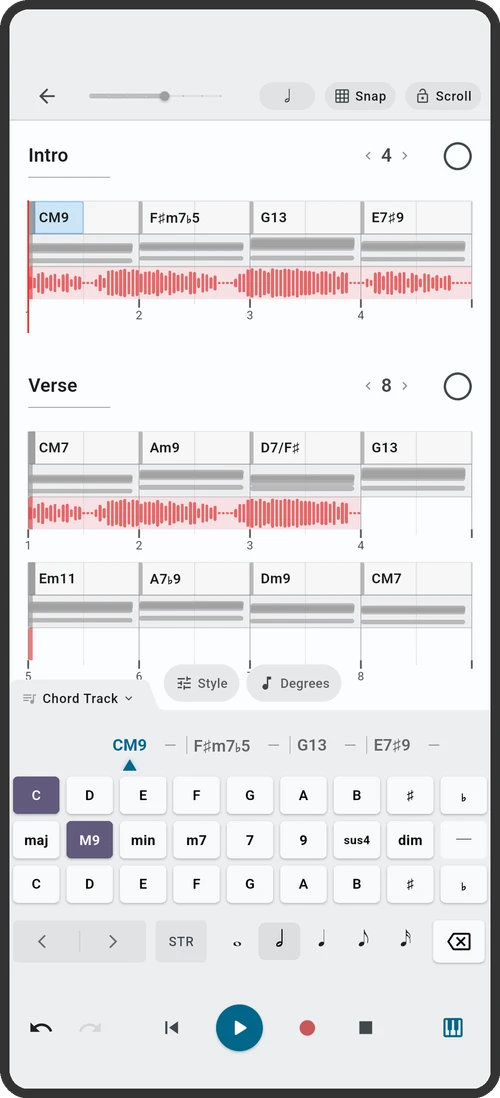
A chord-first app like Faso flips the equation: you start with the chords. Type in a progression — or use Faso's AI to modify your chord sheet: ask it to "make this sound like a jazz standard" or "turn the verse chords into a minor progression." The app shows you what chords fit in your key, handles the voicings, and lets you record vocals, layer MIDI, and build a full arrangement — all on your phone.
Write songs, not notation
You don't need to play an instrument. You don't need to know what a 'diatonic ii chord' is. You just need an idea, and Faso gives you the chords to build it on.
Quick-Start Cheat Sheet
- Pick a key: C major (bright) or A minor (emotional)
- Pick a progression: I–V–vi–IV (C–G–Am–F) never fails
- Loop it 4× = your verse. Reorder it = your chorus
- Record a voice memo of chords + melody right now, before you overthink
- Build from there: add a bridge, layer a second instrument, write lyrics to the rhythm of the chords
You Don't Need Permission to Start
The only difference between someone who "writes songs" and someone who doesn't is that the songwriter started before they felt ready. Chord progressions are your shortcut past the intimidation of music theory. Grab a progression, loop it, hum over it, record it. That's a song.
Everything else — better transitions, chord substitutions, sophisticated voicings — those come later. They're optimization. The first song just needs to exist.