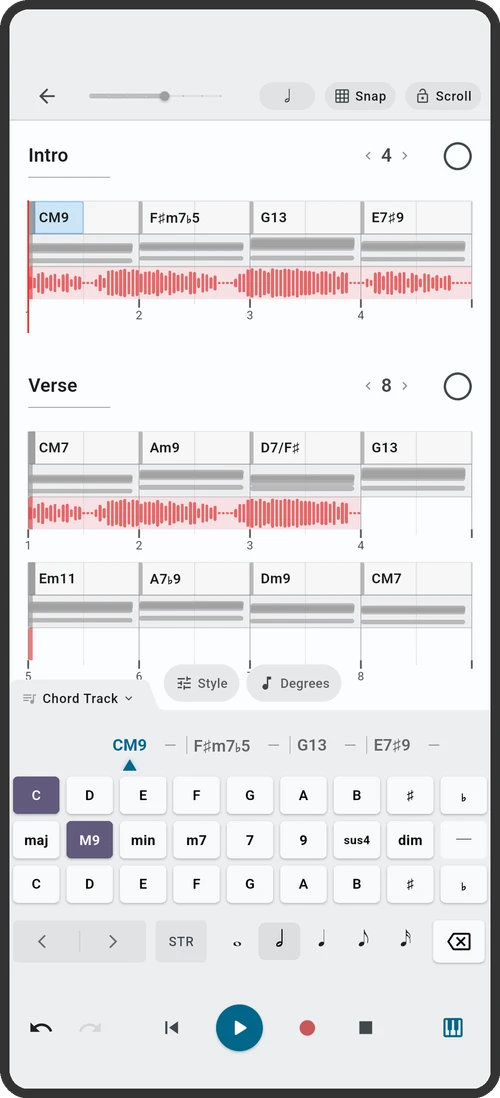
If popular music has a single most influential blues chord progression, it's the 12 bar blues. One form, three chords, twelve bars — and from that simple template came everything from Delta blues to rock and roll, from jazz to R&B, from early country to hip-hop samples. The 12 bar blues is not just a progression: it's a musical conversation structure that musicians have been riffing on for over a century.
This guide covers the structure, the variations, the history, and the practical steps to play and improvise over it — whether you're on guitar, piano, or just building chord sheets on your phone. We'll start with the bare-bones version and build from there.
New to reading chord progression charts? Start with our beginner's guide to chord progression charts — it covers Roman numerals, Nashville numbers, and the fundamentals we'll use here.
What Is the 12 Bar Blues?
The 12 bar blues is a fixed-length chord progression: twelve measures (bars) long, built on three chords — the I, IV, and V of any key. It repeats. Over and over. The form is a cycle: twelve bars, back to the top, twelve bars, back to the top. Soloists take turns improvising over the cycle. Vocalists sing verses that fit the twelve-bar frame. The structure never changes; what you do inside it changes every time.
Three things make the 12 bar blues unique among chord progressions:
- It's a fixed form, not a loop. A I–V–vi–IV pop progression loops every four bars. The blues unfolds over twelve bars with a specific internal shape — tension builds in bars 9–10 and resolves in bars 11–12. You can feel the architecture.
- Every chord is a dominant 7th. In most music, the V chord is dominant and the I is major 7th. In blues, every chord — I, IV, and V — gets a flat 7th. A blues in C uses C7, F7, and G7. That wall-to-wall dominant sound is the blues.
- It's a conversation template. The 12 bar cycle is designed for call and response: play a line (bars 1–4), answer it (bars 5–8), build tension (bars 9–10), resolve (bars 11–12). This structure comes directly from African American work songs and field hollers — it predates the chord progression itself.
The Basic Structure: I–IV–V in Twelve Bars
Here's the standard 12 bar blues in its simplest form. Memorize this pattern — every variation builds on it:
| Bars | Chord | Roman numeral | In C | In G |
|---|---|---|---|---|
| 1 – 4 | I (tonic) | I I I I | C C C C | G G G G |
| 5 – 6 | IV (subdominant) | IV IV | F F | C C |
| 7 – 8 | I (tonic) | I I | C C | G G |
| 9 | V (dominant) | V | G | D |
| 10 | IV (subdominant) | IV | F | C |
| 11 – 12 | I (tonic) | I I | C C | G G |
Read it row by row: four bars of I, two bars of IV, two bars of I, one bar of V, one bar of IV, two bars of I. The V→IV→I in bars 9–12 is called the turnaround — it's the emotional peak of the form, where the tension built over eight bars finally gets released. The last bar (bar 12) often uses a V chord instead of I to create momentum back to the top of the form. This is called a turnaround variation and we'll cover it below.
Memorize this first
Before learning any variations, play the basic 12 bar blues in C, then in G, then in D. Use a metronome or drum loop. Your goal: internalize the twelve-bar shape so deeply that you never have to count bars while playing. Your body should feel "we're at bar 9 now" without your brain checking a chart.
Blues Chord Voicings: Dominant 7ths and Beyond
The standard blues uses dominant 7th chords for all three chords — even the I chord, which would normally be a major 7th in other styles. This is the single most important harmonic characteristic of the blues:
| Chord | Standard (non-blues) | Blues version | Notes in C |
|---|---|---|---|
| I | Cmaj7 | C7 | C E G B♭ |
| IV | Fmaj7 | F7 | F A C E♭ |
| V | G7 | G7 | G B D F |
The flat 7th on the I chord (B♭ in C7) creates a tritone interval between the 3rd (E) and the 7th (B♭) — the same interval that makes the V7 chord want to resolve. Putting that on the I chord means the tonic itself feels slightly unsettled. That gentle, unresolved tension is the emotional core of the blues. It's why a blues in C doesn't sound like a pop song in C, even when they share the same three chords.
Common Variations on the 12 Bar Form
The basic I–IV–V form is the foundation, but blues musicians have been tweaking it for generations. Here are the most common variations you'll encounter:
The Quick IV (Quick Change)
The most common variation: replace the second bar of I with a bar of IV. Instead of four bars of I to start, you get I–IV–I–I. This creates earlier harmonic movement and is used in countless blues standards including "Sweet Home Chicago" and "Hoochie Coochie Man."
| Bars | 1 | 2 | 3 | 4 | 5-6 | 7-8 | 9 | 10 | 11 | 12 |
|---|---|---|---|---|---|---|---|---|---|---|
| Quick IV | I | IV | I | I | IV IV | I I | V | IV | I | V |
The Jazz Blues (Bird Blues)
Charlie Parker's version adds ii–V cadences and chromatic movement, turning the simple three-chord form into a bebop harmonic journey. The key changes: bar 4 gets a ii–V into the IV chord (Gm7→C7→F7), bars 9–10 use chromatic ii–Vs, and bars 11–12 use a I–VI–ii–V turnaround. This is advanced territory — worth knowing about even if you're not ready to comp through it at tempo.
The Minor Blues
Swap all three chords for their minor equivalents (i–iv–v, all minor 7ths) and the blues turns darker, heavier, and more introspective. "The Thrill Is Gone" by B.B. King is the canonical example. In C minor: Cm7–Fm7–Gm7. The minor third (E♭ instead of E) is the single note that changes everything.
Where the Blues Came From: A Brief History
The 12 bar blues emerged in the Mississippi Delta in the late 19th century, born from the collision of African musical traditions (call-and-response, pentatonic scales, rhythmic complexity) and European harmonic instruments (guitar, piano). It was the music of sharecroppers, of field workers, of communities making art under conditions of extreme hardship.
Three turning points in blues history:
- 1920s–1930s: The Delta pioneers. Charley Patton, Son House, and Robert Johnson recorded the first blues 78s. Johnson's "Sweet Home Chicago" and "Cross Road Blues" established the 12 bar form as the standard. His guitar playing — simultaneous bass line, chords, and melody on one instrument — remains the template for solo blues guitar.
- 1940s–1950s: The Chicago migration. Muddy Waters plugged his guitar into an amplifier and the blues got louder, grittier, and more urban. The addition of drums, bass, and harmonica turned the solo Delta style into a full band format — electric Chicago blues. This directly spawned rock and roll: Chuck Berry's "Johnny B. Goode" is a 12 bar blues with a backbeat.
- 1960s–1970s: The British invasion plays the blues. The Rolling Stones, Led Zeppelin, Eric Clapton, and Fleetwood Mac built their early careers on 12 bar blues covers. "The Lemon Song" by Led Zeppelin is a 12 bar blues. "Crossroads" by Cream is a 12 bar blues at 180 BPM. The British blues boom re-exported the form to American audiences and cemented it as the foundation of rock guitar.
The 12 bar blues is arguably the most consequential chord progression in Western popular music. Jazz, rock, R&B, soul, funk, and hip-hop all trace harmonic DNA back to it.
How to Play the 12 Bar Blues on Guitar
The blues lives on the guitar. The blues guitar chords you need to know are surprisingly few — three dominant 7th shapes cover the entire 12 bar form. Here's a practical guide to getting the blues chord sequence under your fingers, starting from absolute basics:
Step 1: Learn the Three Essential Dominant 7th Shapes
| Chord | Frets | Strings | Shape |
|---|---|---|---|
| C7 | x-3-2-3-1-0 | All 6 | Open position, classic blues I chord |
| F7 | 1-3-1-2-1-1 | All 6 | Barre at 1st fret, E-shape dominant |
| G7 | 3-2-0-0-0-1 | All 6 | Open position, classic blues V chord |
These three shapes, in this key, are the first thing every blues guitarist learns. Practice switching between C7 and F7 until it's smooth — that's the IV chord movement that defines the quick change.
Step 2: Apply a Shuffle Rhythm
The blues isn't played in straight eighth notes. It's played with a shuffle — a swung, triplet-based feel where each beat divides into a long-short pattern instead of even subdivisions. Count it as: 1-and-a 2-and-a 3-and-a 4-and-a, playing on the "1" and the "a." This is the rhythmic feel of "Pride and Joy" by Stevie Ray Vaughan and virtually every slow blues ever recorded.
Step 3: Play Through the Form in Time
- Set a metronome or drum loop to 80 BPM with a shuffle feel
- Play C7 for 4 bars (count "1-2-3-4, 2-2-3-4, 3-2-3-4, 4-2-3-4")
- Switch to F7 for bars 5–6
- Back to C7 for bars 7–8
- G7 for bar 9 (tension peaks)
- F7 for bar 10 (release begins)
- C7 for bar 11, G7 for bar 12 (turnaround back to top)
Loop this for 5 minutes without stopping. If you lose your place, don't restart — just find the beat and jump back in. The skill is not playing perfectly; it's recovering smoothly.
Improvising Over the Blues: Pentatonic Scales and Licks
The blues is designed for improvisation. The form's predictable structure means you always know what chord is coming — which means you can plan your melodic ideas in advance, even as you're playing them. Here's what you need to get started:
The Minor Pentatonic Scale (Your First Blues Vocabulary)
In C, the minor pentatonic is: C – E♭ – F – G – B♭ – C. Five notes. Every blues guitarist from B.B. King to John Mayer has built entire solos from these five notes. The magic is in how you play them — bends, slides, vibrato, and phrasing — not in how many notes you use.
The "Blues Scale" (Adding the Tritone)
Add one note to the minor pentatonic — the flattened 5th (G♭ in C) — and you have the blues scale: C – E♭ – F – G♭ – G – B♭ – C. This single added note, the "blue note," creates the characteristic dissonance that defines blues phrasing. Use it sparingly: bend into it, slide off it, never land on it and stay there. It's spice, not the meal.
The "Play the Changes" Approach
Beginners solo using one scale across all three chords. Intermediate players target chord tones — emphasizing the notes of each chord as the blues chord changes pass by. When the IV chord (F7) arrives in bar 5, hit the note F or A or E♭ to signal the chord change in your solo. Listeners feel the chord change even before the rhythm section plays it because your note choice announces it. This is what separates "noodling over a backing track" from actual blues improvisation.
Practice tip
Record yourself playing 12 bars of rhythm (or use a backing track). Then solo over it using ONLY the root, 3rd, and 5th of each chord — three notes per chord, no pentatonic runs. This forces you to outline the changes. Once that's comfortable, add the 7th, then gradually add the pentatonic notes back. You'll be amazed how much more intentional your soloing sounds.
12 Bar Blues Cheat Sheet
- Standard form: 4 bars I — 2 bars IV — 2 bars I — 1 bar V — 1 bar IV — 2 bars I (with V turnaround on bar 12)
- Quick IV: Replace bar 2 of I with IV. Used in "Sweet Home Chicago."
- All dominant 7ths: I7, IV7, V7. No major 7ths in the blues.
- Minor blues: All chords become minor 7ths. i7–iv7–v7. "The Thrill Is Gone."
- Solo scale (minor pentatonic in C): C – E♭ – F – G – B♭ – C. Five notes, infinite possibilities.
- Blue note: Add G♭ to the pentatonic for the full blues scale. Use sparingly.
- Guitar shapes (C): C7 (x-3-2-3-1-0), F7 (1-3-1-2-1-1), G7 (3-2-0-0-0-1)
- Shuffle feel: Swung eighth notes, triplet-based. Not straight. Not dotted. Shuffled.
The 12 bar blues is the closest thing popular music has to a universal language. Learn it in C. Then learn it in G, D, A, and E — the guitar-friendly keys. Then put on a backing track and solo over it for ten minutes. The form will start to feel like a room you know the shape of, even with the lights off.
Write songs, not notation
Pick a key, set your 12 bar blues progression, and record over it. Faso lets you build blues from chord sheets — no notation, no theory, just the chords and your ideas.