You know the chords. You can play C, G, Am, F — each one sounds fine on its own. But when you try to string them together in a song, there's a gap. A pause. A buzz. Your fingers scramble into position while the rhythm dies. Chord changes are the silent skill that separates people who "know chords" from people who actually play songs.
The good news: if you want to learn how to switch chords fast on guitar, it's not about finger speed or natural talent. Smooth guitar chord transitions come from technique — a handful of specific, learnable habits — pivot fingers, leading with the bass, visualization — will close the gap between chords faster than any amount of mindless repetition. This guide covers five proven techniques, a daily practice routine, and the mistakes that keep most players stuck.
If you're still learning the basic chord shapes, start with our chord progression chart guide first — it covers the Roman numeral system and essential progressions that pair perfectly with these exercises.
Why Chord Changes Matter (More Than the Chords Themselves)
A song isn't a series of isolated chords. It's a continuous stream of sound. The transition between chords is where the music actually lives. When changing guitar chords, even a 200-millisecond gap is audible — and it breaks the groove. The listener doesn't think "ah, a slow chord change." They think "this doesn't feel right."
There are three things that have to happen during every chord change:
- Your fingers release the current chord
- Your fingers move through the air to the new position
- Your fingers land and press the new chord
Beginners treat these as three sequential steps — release, move, land. Intermediate players merge them into one fluid motion. The techniques below are all about collapsing those three steps into something that feels — and sounds — like a single action.
Tip 1: Find the Pivot Finger
When two chords share a note in the same position, leave that finger down. This is the pivot finger — it stays anchored while your other fingers reposition around it. The pivot finger gives your hand a fixed reference point, so you're moving fewer fingers and landing with more confidence.
Here are the pivot fingers for the most common guitar chord transitions:
| Transition | Pivot finger | Shared note | What stays |
|---|---|---|---|
| C → Am | Index + middle | C, E | Index on 1st fret B string, middle on 2nd fret D string |
| G → Em | Index | G (open) | Index on 2nd fret A string stays; other fingers lift |
| C → F | Index | C | Index on 1st fret B string stays for both chords |
| Am → F | Index | A | Index on 1st fret B string stays; middle and ring shift |
| D → G | Ring | G | Ring on 3rd fret B string stays; everything else moves |
Before you practice a new chord change, freeze on the first chord and ask: "Which finger, if any, doesn't need to move?" That's your pivot. Build the rest of the change around it.
Tip 2: Lead With the Bass Note
Your right hand (or strumming hand) doesn't need to wait for your left to finish fretting. Strum the bass note of the new chord while your other fingers are still landing. This buys you an extra fraction of a second and anchors the chord change in the listener's ear before the full voicing arrives.
How to practice this: strum only the lowest 2-3 strings on beat 4 of the bar, giving your left hand the entire beat to complete the full chord shape. For C → G: play the full C chord on beats 1-3, then on beat 4 strum only the low G string (6th string, 3rd fret) while your fingers finish forming the G chord. By beat 1 of the next bar, your full G shape is ready and you strum all six strings.
The rule
Bass note first, full chord second. Never the other way around. The bass note defines the harmony; the rest of the chord is texture. If you can only land one note in time, make it the bass note.
Tip 3: Visualize the Destination Before You Move
Your brain can picture a chord shape faster than your fingers can form it. Before you lift your hand, look at the fretboard and mentally see exactly where each finger needs to land. This isn't woo-woo advice — it's motor learning science. Athletes do this before free throws. Surgeons do this before incisions. Guitarists should do this before chord changes.
The drill: play a C chord. Look at the fretboard. In your mind, see your fingers in the G chord shape — not "G chord" as an abstract idea, but the specific frets: index on 2nd fret A string, middle on 3rd fret low E, ring on 3rd fret B string. Then move. Do this for every change in a practice session for one week. You'll notice your changes feel less rushed and more intentional, even when you're playing at tempo.
Tip 4: Slow Loop Between Two Chords Only
The most efficient way to improve changing guitar chords is not to practice full songs. It's to isolate the hardest transition in the song and loop it:
- Strum chord A once, whole note (4 beats)
- Change to chord B during the silence between strums
- Strum chord B once, whole note
- Change back to A during the silence
- Repeat at a tempo where you can land cleanly 10 times in a row
The key phrase is "at a tempo where you can land cleanly." If that's 40 BPM, it's 40 BPM. Speed comes from clean reps, not fast sloppy ones. Every guitarist who changes chords effortlessly at 120 BPM got there by doing hundreds of clean reps at 60.
Tip 5: Drill the Most Common Chord Pairs
You don't need to practice every possible chord combination. You need to drill the pairs that actually show up in songs. Here are the five highest-value guitar chord exercises, ranked by how often they appear in real music:
| Priority | Chord pair | Appears in | What to focus on |
|---|---|---|---|
| 1 | G ↔ C | Country, folk, pop | Index does the most work — keep it relaxed |
| 2 | C ↔ Am | Ballads, pop | Two-finger pivot — easiest transition, build confidence here |
| 3 | G ↔ D | Rock, blues | Ring finger pivot on B string — this is your first "real" test |
| 4 | Am ↔ F | Pop, folk | Barre-to-open transition — the hardest jump for beginners |
| 5 | Em ↔ Am | Minor-key songs | One-finger shift — good warmup, builds speed confidence |
Spend 60 seconds on each pair per practice session. That's your five-minute warmup. Do this daily for two weeks and your guitar chord transitions will be unrecognizably smoother.
How to Change Chords Quickly: A 5-Minute Daily Routine
The question every beginner asks — guitar how to switch chords quickly — has one honest answer: targeted daily reps on the specific changes that give you trouble. Here's the routine:
- Minute 1: G ↔ C loop. 40 BPM, clean landing only. If you buzz, slow down. Count the clean reps.
- Minute 2: C ↔ Am loop. 50 BPM. This should be your easiest pair.
- Minute 3: G ↔ D loop. 40 BPM. Focus on the ring-finger pivot.
- Minute 4: Am ↔ F loop. 35 BPM. Barre chord transition — be patient.
- Minute 5: Play G–C–Am–F as a full four-chord loop at a tempo where all four changes are clean. Note which transition is the weakest — that's tomorrow's focus pair.
Three Mistakes That Slow Your Chord Changes Down
- Looking at your strumming hand. Your eyes need to be on the fretboard during chord changes — that's where the action is. Your strumming hand can feel its way. If you're watching your right hand, your left hand is navigating blind.
- Lifting all fingers off the fretboard between chords. This is the "helicopter hand" — every finger comes off, the hand floats, then all fingers land simultaneously. It's slow and inconsistent. Always leave at least one finger in contact with the strings, even if it's just grazing them. Physical contact gives your hand a spatial reference.
- Practicing only at full-song tempo. When you practice I-V-vi-IV at 100 BPM and stumble on the same transition every time, you're not practicing the transition — you're practicing the stumble. Isolate the hard change. Slow it down. Get 10 clean reps. Then reintegrate it into the song.
Chord Change Drills Cheat Sheet
- Pivot finger rule: before every change, ask "which finger doesn't need to move?" Leave that one down.
- Bass first: strum the bass note of the new chord on beat 4 while fingers finish landing.
- Visualize before moving: see the destination chord shape on the fretboard before you lift your hand.
- Isolate and loop: practice the single hardest change in a song, two chords only, at a tempo where you land clean.
- Top 5 pairs to drill: G↔C, C↔Am, G↔D, Am↔F, Em↔Am. 60 seconds each daily.
- Speed rule: only increase tempo after 10 clean reps at the current speed. Accuracy first, always.
- Keep contact: never lift all fingers off the strings between chords. Maintain spatial reference.
Chord changing is not a talent. It's a motor skill — like typing, like shifting gears, like any physical movement you learned through repetition. The five techniques above give you the strategy. The five-minute routine gives you the reps. The rest is showing up.
Write songs, not notation
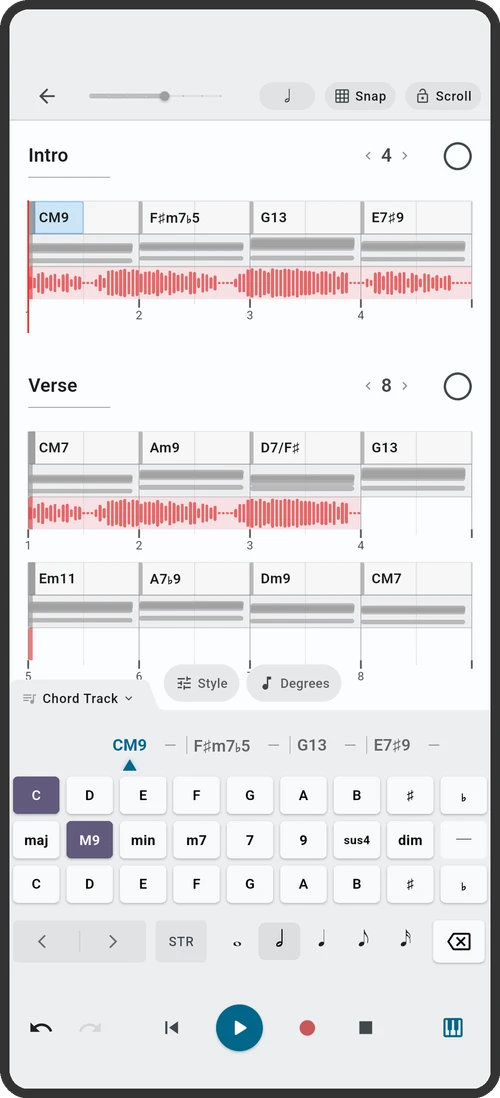
Once your chord changes are smooth, Faso gives you the canvas: pick a progression, set your tempo, and start recording. The chord-sheet view shows you exactly which chords are coming — so your fingers are already in position before the change.