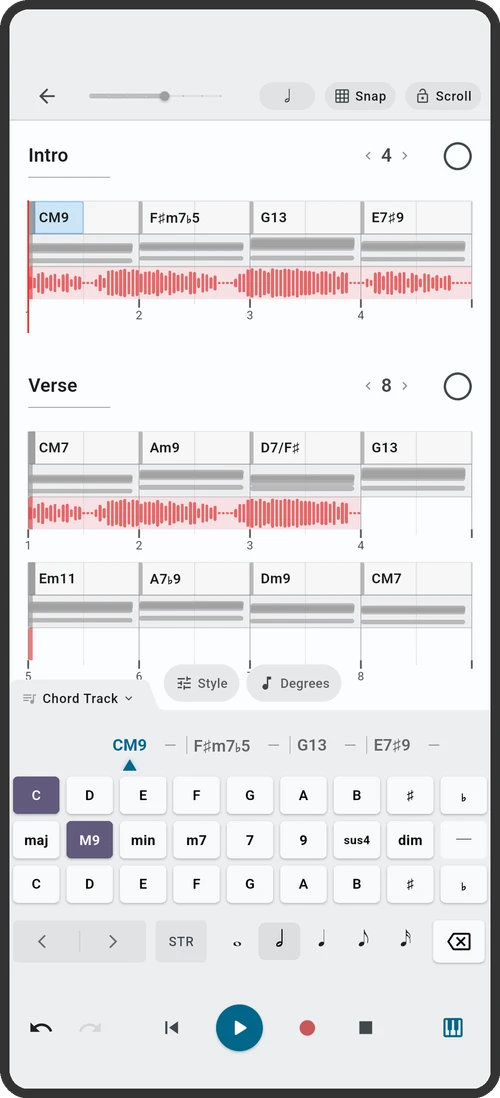
Jazz chord progressions have a reputation for being complicated — dense chord symbols, altered extensions, substitutions that seem to come from nowhere. If you've ever looked at a jazz lead sheet and thought "Dm7♭5? G7alt? What am I supposed to do with this?" — this guide is for you.
Underneath the complexity, jazz harmony follows a small set of recurring patterns. These common jazz chord progressions and jazz chord patterns — the ii-V-I, the turnaround, the tritone substitution — show up in hundreds of standards. Once you recognize the patterns, the chord symbols stop being a puzzle and start being a map. This guide covers the essential progressions, the chord structures that make them work, and practice strategies to get them into your fingers.
If you're brand new to chord progressions in general, start with our beginner's guide to reading chord progression charts first — it covers Roman numerals, Nashville numbers, and the fundamentals that we'll build on here.
What Makes Jazz Chord Progressions Different
A pop song might use four triads: C – G – Am – F. A jazz tune takes the same skeleton and adds sevenths, extensions, and alterations — turning C into Cmaj7(♯11), G into G7(♭9♭13), Am into Am9, and F into Fmaj7(♯11). The underlying progression (I–V–vi–IV) is the same. The sound is richer, more colorful, and more harmonically mobile.
Three things distinguish jazz progressions from pop or rock:
- Every chord gets a seventh. Triads are rare. Maj7, min7, dom7, and half-diminished (m7♭5) are the default vocabulary.
- Chords move in functional cycles. Jazz progressions tend to move by fifths (counterclockwise on the circle of fifths) rather than by step. The ii-V-I is a chain of two consecutive fifth movements.
- Substitutions are expected, not exceptional. Jazz musicians routinely replace a V chord with its tritone sub, swap a I for a iii, or insert chromatic passing chords. The chart is a suggestion, not a rule.
Jazz Chord Structure: Sevenths, Extensions, and Alterations
Before diving into progressions, a quick primer on the chord types you'll encounter:
| Chord type | Symbol | Notes (in C) | Sound |
|---|---|---|---|
| Major 7th | Cmaj7, C△7 | C E G B | Warm, mellow, "lounge" |
| Dominant 7th | C7 | C E G B♭ | Tense, wants to resolve |
| Minor 7th | Cm7, C-7 | C E♭ G B♭ | Smooth, soulful |
| Half-diminished | Cm7♭5, Cø | C E♭ G♭ B♭ | Unstable, melancholic |
| Diminished 7th | C°7 | C E♭ G♭ B♭♭ (A) | Tense, symmetrical |
Extensions (9ths, 11ths, 13ths) stack additional thirds on top: Cmaj9 = C E G B D. Alterations raise or lower specific extensions: G7(♭9) has an A♭ on top of a G7. You don't need to memorize all of these on day one — but recognizing the five basic seventh-chord types above gets you 80% of the way through any jazz standard.
The ii-V-I: The DNA of Jazz Harmony
If jazz harmony has one building block, it's the ii-V-I. This three-chord sequence appears constantly — at the ends of phrases, as transitions between sections, and as the harmonic engine of entire tunes. It works because each chord moves down a fifth: ii → V is a fifth down, V → I is another fifth down. Two consecutive resolutions create a powerful sense of forward motion.
In any key: find the ii chord (a minor 7th built on the second scale degree), the V chord (a dominant 7th built on the fifth), and the I chord (a major 7th on the tonic). In C: Dm7 → G7 → Cmaj7. In F: Gm7 → C7 → Fmaj7. In B♭: Cm7 → F7 → B♭maj7. The formula never changes — only the starting note does.
Practice this first
Play ii-V-I in all 12 keys around the circle of fifths. Start in C (no sharps/flats), then move to F (one flat), then B♭ (two flats), etc. This single exercise teaches you more about jazz harmony than any amount of reading. Ten minutes a day, one new key per session.
The I-vi-ii-V Turnaround and Its Variations
The I-vi-ii-V (one-six-two-five) is the most common turnaround in jazz — a four-chord sequence that loops back to the beginning. You'll hear it at the end of almost every jazz standard phrase, setting up the return to the top of the form:
The vi chord (Am7) functions as a "stand-in" for the I — it shares three notes with Cmaj7 (C, E, G). This substitution is so common that some jazz musicians think of I and vi as functionally interchangeable. The sequence I → vi → ii → V is a chain of fifth movements (I to vi is a sixth, but vi to ii is a fifth, ii to V is a fifth, V back to I is a fifth).
The Ladybird Turnaround
Tadd Dameron's famous variation on I-vi-ii-V makes every chord a major 7th — and then substitutes tritone replacements, creating a chromatically descending bass line: Cmaj7 → E♭maj7 → A♭maj7 → D♭maj7. This is the sound of bebop harmony in a single four-chord sequence. It's used in dozens of compositions, most famously Dameron's own "Lady Bird."
Minor ii-V-i: The Darker Side of Jazz
The ii-V-I works differently in minor keys. The ii chord becomes half-diminished (m7♭5) instead of minor 7th, and the V chord is almost always altered (♭9, ♯9, or ♭13) to heighten the tension:
The half-diminished ii chord (Dm7♭5 = D F A♭ C) creates a darker, more unsettled tension than the minor 7th ii of the major version. The altered V (G7♭9 = G B D F A♭) intensifies that tension before resolving to the minor i. This progression is the emotional core of minor-key jazz standards like "Autumn Leaves," "Blue Bossa," and "Summertime."
The Tritone Substitution: Jazz's Favorite Harmonic Trick
Here's the cleverest trick in jazz harmony: any dominant 7th chord can be replaced by another dominant 7th chord a tritone (three whole steps) away. In C major, the V chord is G7. Its tritone is D♭. So G7 → Cmaj7 becomes D♭7 → Cmaj7.
Why does this work? The two most important notes in a dominant 7th chord — the 3rd and the 7th — create a tritone interval. In G7, those notes are B and F. In D♭7, the 3rd is F and the 7th is C♭ (which is B). Same two notes, swapped roles. The rest of the chord can change, but the essential tension stays the same.
The tritone sub creates a chromatic bass line — D♭ slides down a half-step to C — which sounds smoother and more sophisticated than the original V-I leap. You'll hear this in virtually every bebop tune and in the comping of every great jazz pianist and guitarist from Bud Powell to Pat Metheny.
Jazz Guitar Progressions: Voicings and Shell Chords
Jazz notes guitar players face a unique challenge: you have six strings but only four fingers (plus your thumb for the low E), and you need to voice chords that often contain five, six, or seven notes. The solution: shell chords and drop voicings.
Shell Chords (the 3-Note Solution)
A shell chord plays only the three most essential notes of any seventh chord: the root, 3rd, and 7th. The 5th is omitted (it adds no color), and extensions are added back selectively once the shell is secure.
| Shell chord | Strings | Notes | Used for |
|---|---|---|---|
| Root-3rd-7th (Cmaj7) | 5-4-3 | C E B | Any maj7, min7, or dom7 |
| Root-7th-3rd (G7) | 6-4-3 | G F B | Dominant chords with punch |
| 3rd-7th-Root (Dm7) | 4-3-2 | F C D | Smooth voice leading between chords |
Why shell chords matter: they remove the inessential notes, making chord changes faster and cleaner. A shell-chord ii-V-I in C — Dm7 (D F C on strings 5-4-3), G7 (G F B on 6-4-3), Cmaj7 (C E B on 5-4-3) — moves each voice by no more than a whole step. That smoothness is the hallmark of professional jazz comping.
Guitar practice tip
Learn three shell-chord shapes (one for major 7th, one for minor 7th, one for dominant 7th) on the D-G-B string set (strings 4-3-2). Play ii-V-I in C using only these three shapes. Once you can do it smoothly, move the whole thing to F (Gm7 → C7 → Fmaj7). Then around the circle of fifths. This is not an exercise — it's how jazz guitarists actually comp on bandstands.
Practice Tips and Listening Recommendations
Jazz progressions live in your ears before they live in your fingers. Here's how to internalize them:
Practice Exercises
- Play ii-V-I in all 12 keys. Start in C, move counterclockwise around the circle of fifths (C → F → B♭ → E♭ → A♭ → D♭ → G♭ → B → E → A → D → G). Ten minutes a day. This is the single highest-leverage exercise in jazz.
- Voice-lead shell chords. Pick two chord types (e.g., ii-V) and move between them using only shell voicings on the same string set. Minimize finger movement — the closest available voicing is almost always the right one.
- Transcribe one ii-V-I lick. Find a recording of a jazz musician you like playing over a ii-V-I. Learn the lick by ear in one key, then transpose it to all 12. Your vocabulary will expand exponentially faster than learning from books.
- Apply tritone subs to simple tunes. Take a basic I-V-vi-IV progression and replace every V chord with its tritone sub. Notice how the bass line changes and the harmony sounds more sophisticated with zero additional effort.
Essential Listening (Start Here)
| Album / Track | Artist | What to listen for |
|---|---|---|
| "Autumn Leaves" | Bill Evans Trio | Perfect ii-V-I voice leading throughout |
| "So What" | Miles Davis | Minimal chord movement — two chords for the whole tune. Hear how much space creates tension. |
| "All the Things You Are" | Charlie Parker | A masterclass in ii-V-I chains through multiple key centers |
| "Misty" | Erroll Garner | Rich major 7th and extended chord voicings on piano |
| "Blue Bossa" | Joe Henderson | Minor ii-V-i in action, plus a clear I-vi-ii-V turnaround |
Jazz Progressions Cheat Sheet
- ii-V-I (major): Dm7 → G7 → Cmaj7 in C. The fundamental cadence. Learn it in all 12 keys.
- ii-V-i (minor): Dm7♭5 → G7alt → Cm7 in C minor. Half-diminished ii + altered V.
- I-vi-ii-V turnaround: Cmaj7 → Am7 → Dm7 → G7 in C. Ends every standard phrase.
- Tritone sub: Replace V7 with ♭II7. G7 → D♭7. Same tension, chromatic bass line.
- Shell chords (guitar): Root-3rd-7th only. Omit the 5th. Three notes, played on strings 4-3-2 or 5-4-3.
- Chord qualities: Maj7 (warm), min7 (smooth), dom7 (tense), m7♭5 (unstable), dim7 (symmetrical).
- Voice leading rule: move each finger the shortest possible distance between chords. Smoothness over complexity.
Every progression jazz musicians use — the ii-V-I, the turnaround, the tritone sub — shows up again and again because it sounds good and it works. Jazz chord progressions aren't magic — they're patterns. Learn the patterns in one key, then move them around the circle of fifths. Your ears will catch up to your fingers faster than you expect.
For the non-jazz fundamentals — Roman numerals, Nashville numbers, and how to read chord charts — revisit our complete guide to chord progression charts.
Write songs, not notation
When you're ready to apply these jazz progressions, Faso gives you a chord-sheet canvas: pick your key, build your ii-V-I, and record over it. No notation needed — just the chords and your ideas.