
You already know the basic pop chord progressions — I-V-vi-IV, vi-IV-I-V, I-IV-V. They're in the pillar guide. This article is about what comes next: how to use them. Why does the same four-chord loop sound like a funeral in one song and a party in another? How do producers turn three chords into a career? And how do you write a pop song chord progression that doesn't sound like a theory exercise?
We'll go beyond the Roman numerals — real song dissections, production-level thinking, and a writing workflow that starts from sound, not notation. The goal: you'll know not just which pop song chords to play, but why those specific choices sold millions of records. If you need the fundamentals first, read our complete guide to chord progression charts.
What Pop Chord Progressions Actually Do (That Theory Won't Tell You)
Music theory describes pop music chord progressions as "diatonic sequences in a major key." True, but useless. What they actually do is manage emotional energy across time. Every chord change is either building tension or releasing it. A great pop progression is one where the build-release cycle matches the emotional arc of the lyrics and the energy level of the production.
The best pop producers don't think "I'm playing a deceptive cadence from V to vi." They think "the chorus needs to feel bigger than the verse — what do I change?" The answer is almost always one of three things: starting point, chord duration, or production density. Same four chords, three knobs to turn.
The Four-Chord Blueprint: I-V-vi-IV Under a Microscope
You know the chords: C – G – Am – F. What you might not know is that every bar of this pop music chord progression has a specific emotional job:
| Bar | Chord | Emotional role | Production trick |
|---|---|---|---|
| 1 | I (C) | Home. Stable. Grounding. | Keep it sparse. Let the vocal carry. |
| 2 | V (G) | Forward motion. "Something's happening." | Add a light drum fill at the end of this bar. |
| 3 | vi (Am) | Emotional pivot. The surprise. | This is where the synth pad or backing vocal enters. |
| 4 | IV (F) | Lift. "We're going somewhere." | Open hi-hat, full kit. Everything peaks here. |
Listen to "Let It Be" with this table in mind. Bar 1: solo piano, C chord. Bar 3: backing vocals enter on Am. Bar 4: the band swells on F. Paul McCartney didn't write this with a spreadsheet — but the emotional choreography is the same every time the loop repeats.
The chorus secret
The I-V-vi-IV loop works for verses at low energy. For choruses, keep the same four chords but cut each chord's duration in half — two beats per chord instead of four. The faster harmonic rhythm makes the same progression feel urgent and climactic. Zero new chords required.
Same Chords, Different Start: The vi-IV-I-V Flip
vi-IV-I-V is I-V-vi-IV starting on bar 3. Same four pop song chords. Completely different emotional trajectory. Starting on vi means the progression begins in minor territory and takes two full bars to reach the I chord — which is why this version dominates ballads:
Adele's "Someone Like You" uses this exclusively. The first chord you hear is Am — the song announces sadness in bar one. When C major arrives in bar three, it feels like a memory of happiness rather than happiness itself. That's the entire emotional thesis of the song, delivered by chord order alone.
When Three Is Enough: Making I-IV-V Sound Modern
I-IV-V is the oldest pop progression in the book. "Twist and Shout," "La Bamba," "Wild Thing" — it powered early rock and roll. The challenge: how do you use common pop chord progressions this basic in 2026 without sounding retro? Three answers:
- Rhythm first. "Uptown Funk" is I-IV-V underneath — but the swung sixteenth-note groove, the syncopated guitar stabs, and the horn section make it sound completely contemporary. The chords are 1955. The production is 2014.
- Inversions change everything. Most pop guitar chords are played in open position — but moving to barre inversions or using a capo to shift the voicing makes the same three chords sound fresh. Play C–F–G in root position and it sounds like a campfire. Play C (root), F/A (first inversion, A in the bass), G/B (first inversion, B in the bass) and the bass line walks up smoothly.
- Don't loop it — structure it. "Sweet Child O' Mine" uses I-IV-V for the verse but switches to a vi-IV-I-V for the chorus. Breaking the three-chord loop at the chorus is what makes the song feel like it has sections, not just one idea on repeat.
Chord Progressions of Popular Songs: Three Case Studies
Let's go deeper than "this song uses I-V-vi-IV." Let's look at how the chord progressions of popular songs interact with arrangement, dynamics, and structure:
Case 1: "Blinding Lights" — The Weeknd (vi-IV-I-V, Fm)
The pop song chord progression is Fm–D♭–A♭–E♭ — a minor-key vi-IV-I-V in A♭ major. Four chords, entire song. What makes it work: the relentless eighth-note synth pulse never stops. The chord changes happen under a constant rhythmic surface, so you feel the harmony shift without losing the driving energy. Takeaway: when your progression is simple, lock the rhythm. Harmonic change + rhythmic consistency = hypnotic. Change either one mid-song and you break the spell.
Case 2: "drivers license" — Olivia Rodrigo (I-V-vi-IV, B♭)
B♭–F–Gm–E♭, looped. The verse is piano + whisper vocal (low energy, sparse). The chorus is the same four chords with full drums, doubled vocals, and synth layers (high energy, dense). The progression never changes. Only the production does. This is the defining feature of contemporary pop songwriting: static harmony, dynamic arrangement. The chord progression is the canvas; the production is the painting.
Case 3: "Levitating" — Dua Lipa (vi-II-V-I, Bm)
Bm–E–A–D — a variation of the classic ii-V-I dressed in disco production. The E major chord is borrowed from outside the key (it should be Em in B minor), creating a bright lift that defines the song's euphoric feel. Takeaway: one borrowed chord in an otherwise diatonic progression is the most efficient way to make a pop progression distinctive. Don't rewrite the form — swap one chord.
Write Pop Progressions Like a Producer, Not a Theorist
The theorist asks "which chords are diatonic to this key?" The producer asks "what does this loop feel like at 90 BPM with a half-time drum groove?" Both questions are valid. Only one gets songs finished. Here's a producer's workflow for writing common pop chord progressions:
- Start from a reference track. Pick a song whose vibe you want. Steal its progression — not the specific chords, but the Roman numeral pattern. Changing the key and tempo makes it legally and creatively distinct.
- Set the tempo first. Before you pick chords, set a BPM. 70-85 = ballad territory. 100-120 = pop. 120-140 = dance. The tempo determines which chord durations feel natural.
- Decide harmonic rhythm. One chord per bar = spacious, emotional. Two chords per bar = driving, urgent. The same progression at different harmonic rhythms is effectively two different progressions.
- Write the chorus progression first. Then simplify it for the verse (maybe drop to two chords). The chorus is the peak — everything else builds toward it.
- Record the vocal melody over the loop. Don't write melody on paper. Loop the progression, hit record, and hum. The best melodies come from reacting to the chords, not from planning them.
- Vary one element per section. Verse → chorus: maybe the progression stays the same but the drums double in intensity. Or the progression changes but the rhythm stays. Never change everything at once — the listener needs continuity.
Write songs, not notation
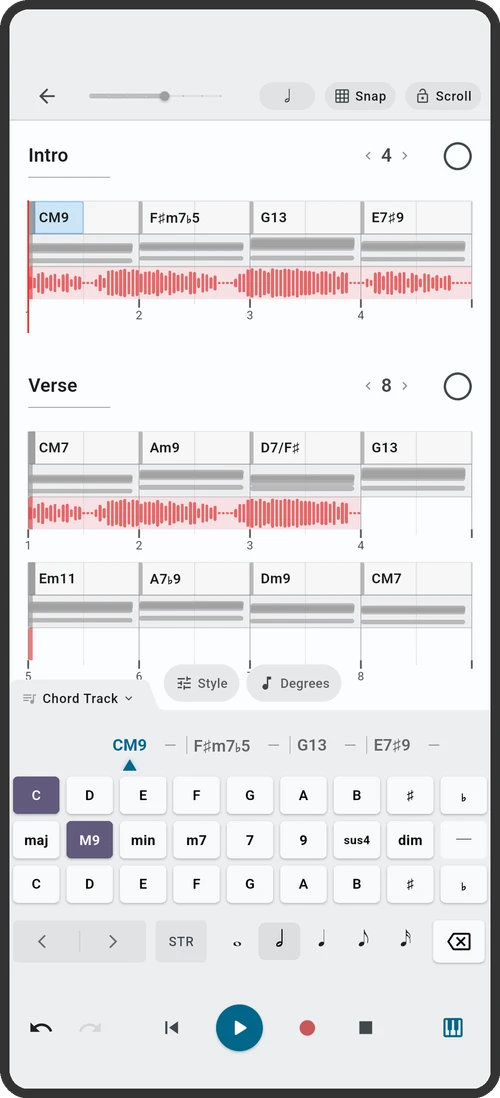
Pick a reference track, set your tempo, and build your pop progression on Faso's chord-sheet canvas. Record vocals and layers immediately — the chords are handled.
Pop Progressions in Action: Cheat Sheet
- I-V-vi-IV: The four-chord blueprint. Emotional jobs: I=home, V=motion, vi=surprise, IV=lift. Use at 2 beats/chord for choruses.
- vi-IV-I-V: Same chords, sadder start. Ballad default. "Someone Like You," "Blinding Lights."
- I-IV-V: Modernize with inversions (C–F/A–G/B for a walking bass) and structural breaks at the chorus.
- Harmonic rhythm: 4 beats/chord = spacious. 2 beats/chord = urgent. Same progression, different feel.
- Static harmony, dynamic arrangement: Keep the progression, change the production density. Modern pop's defining technique.
- One borrowed chord: Replace one diatonic chord with an outside chord for instant distinctiveness.
- Reference, don't reinvent: Steal the Roman numeral pattern. Change the key, tempo, and melody. That's your song.
Pop progressions aren't a mystery — they're a small vocabulary used intelligently. Learn the patterns, learn the production tricks, then spend your creative energy on what actually makes a song yours: the words you sing over those four chords.