You're looking at a piece of sheet music and see a cluster of ♯ or ♭ symbols stacked next to the clef. What do they mean? How do you know what key the song is in? If you've ever felt lost at this exact moment, this guide is for you.
Key signatures look intimidating, but identifying them follows two simple rules — one for sharps, one for flats. Once you memorize these rules (and the order sharps and flats appear in), you'll be able to name any key signature in under five seconds. This guide covers everything: the identification tricks, the circle of fifths, relative minors, and a practice plan to make it stick.
If you're brand new to sheet music entirely, start with our complete beginner's guide to reading sheet music first — it covers the staff, clefs, and note names that we'll build on here.
What Is a Key Signature, Exactly?
A key signature is the group of sharp (♯) or flat (♭) symbols placed between the clef and the time signature at the beginning of a piece of music. It tells you two things:
- Which notes are permanently sharp or flat throughout the piece (unless overridden by an accidental).
- What key the music is in — which chord feels like "home" and which seven notes the melody will primarily use.
A key signature will never mix sharps and flats. It's either all sharps, all flats, or nothing at all. If you see nothing between the clef and the time signature, you're in C major (or A minor) — no sharps, no flats.
Key insight
The key signature is not the same thing as the key. The key signature is the notation — the symbols on the page. The key is the musical result — which note feels like home. A single key signature can represent both a major key and its relative minor. We'll cover how to tell which is which below.
The Order of Sharps and Flats (Memorize This Once)
Sharps and flats are never added randomly. They follow a fixed, unchanging sequence. Memorize this sequence once and you'll know it forever.
Order of Sharps
F♯ – C♯ – G♯ – D♯ – A♯ – E♯ – B♯
Mnemonic: Father Charles Goes Down And Ends Battle.
Order of Flats
B♭ – E♭ – A♭ – D♭ – G♭ – C♭ – F♭
Mnemonic: Battle Ends And Down Goes Charles' Father — it's the exact reverse of the sharps order.
If the key signature has 3 sharps, those sharps are always F♯, C♯, and G♯ — the first three from the sequence. If it has 2 flats, they're always B♭ and E♭. There is no key signature with, say, just C♯ and D♯ but no F♯. The order is absolutely rigid.
How to Identify Sharp Keys: The Half-Step-Up Trick
For any key signature with sharps, do this:
- Find the last sharp — the one furthest to the right.
- Go up one semitone (one half-step, the very next key on a piano).
- That note name is your major key.
Examples:
| Sharps in signature | Last sharp | Up a half-step | Key |
|---|---|---|---|
| 1 (F♯) | F♯ | G | G major |
| 2 (F♯, C♯) | C♯ | D | D major |
| 3 (F♯, C♯, G♯) | G♯ | A | A major |
| 4 (F♯, C♯, G♯, D♯) | D♯ | E | E major |
Why this works: the last sharp in any key signature is always the leading tone — the 7th note of the scale, which sits a half-step below the tonic (the 1st note, the key name). So going up one semitone from the last sharp always lands you on the tonic.
See the two sharps sitting between the clef and time signature? The last sharp is C♯. Up one semitone = D. That's the key.
How to Identify Flat Keys: The Second-to-Last Flat Rule
For any key signature with flats, the rule is even simpler:
- Find the second-to-last flat in the signature.
- That flat's letter name is your major key.
Examples:
| Flats in signature | Flats listed | 2nd-to-last flat | Key |
|---|---|---|---|
| 2 (B♭, E♭) | B♭, E♭ | B♭ | B♭ major |
| 3 (B♭, E♭, A♭) | B♭, E♭, A♭ | E♭ | E♭ major |
| 4 (B♭, E♭, A♭, D♭) | B♭, E♭, A♭, D♭ | A♭ | A♭ major |
The one exception: F major has only one flat (B♭). There is no "second-to-last" flat, so you just have to memorize this one: one flat = F major.
One flat (B♭). No second-to-last to look at — just remember: one flat = F major.
Why this works: in flat key signatures, the second-to-last flat is always the tonic of the major key. The last flat is the 4th scale degree (the subdominant). This pattern holds for every flat key from 2 flats up to 7 flats.
Two flats: B♭ and E♭. Second-to-last flat is B♭ — that's the key. Works every time.
All 15 Key Signatures at a Glance
Here's every key signature you'll encounter, from zero sharps/flats through seven of each. (Keys with 6 or 7 sharps/flats are rarer but absolutely worth knowing.)
| # | Sharps / Flats | Major Key | Relative Minor |
|---|---|---|---|
| 0 | (none) | C major | A minor |
| 1♯ | F♯ | G major | E minor |
| 2♯ | F♯, C♯ | D major | B minor |
| 3♯ | F♯, C♯, G♯ | A major | F♯ minor |
| 4♯ | F♯, C♯, G♯, D♯ | E major | C♯ minor |
| 5♯ | F♯, C♯, G♯, D♯, A♯ | B major | G♯ minor |
| 6♯ | F♯, C♯, G♯, D♯, A♯, E♯ | F♯ major | D♯ minor |
| 7♯ | F♯, C♯, G♯, D♯, A♯, E♯, B♯ | C♯ major | A♯ minor |
| 1♭ | B♭ | F major | D minor |
| 2♭ | B♭, E♭ | B♭ major | G minor |
| 3♭ | B♭, E♭, A♭ | E♭ major | C minor |
| 4♭ | B♭, E♭, A♭, D♭ | A♭ major | F minor |
| 5♭ | B♭, E♭, A♭, D♭, G♭ | D♭ major | B♭ minor |
| 6♭ | B♭, E♭, A♭, D♭, G♭, C♭ | G♭ major | E♭ minor |
| 7♭ | B♭, E♭, A♭, D♭, G♭, C♭, F♭ | C♭ major | A♭ minor |
Notice that some keys overlap: B major (5♯) sounds the same as C♭ major (7♭), and F♯ major (6♯) sounds the same as G♭ major (6♭). These are called enharmonic equivalents — same pitch, different spelling. Which one you use depends on context, but for identification purposes, either name is correct.
The Circle of Fifths: Your Visual Cheat Code
The circle of fifths is a diagram that arranges all 12 keys in a circle where each step clockwise adds one sharp and each step counterclockwise adds one flat. It's the single most useful visual reference in music theory.
Here's how to use it:
- Find any key on the circle. The number next to it tells you how many sharps or flats it has.
- Keys next to each other share all but one note — moving between adjacent keys on the circle sounds smooth and natural. This is why I–IV–V and I–V–vi–IV progressions work so well: those chords come from neighboring keys on the circle.
- The relative minor of any major key sits directly inside it on the inner ring of the circle. C major / A minor, G major / E minor, etc.
You don't need to memorize the circle. Bookmark a good one, or keep a printed copy near your instrument. After a few weeks of regular use, the relationships start to feel intuitive.
Relative Minors: Same Signature, Different Feel
Every key signature represents two possible keys: a major key and its relative minor. They share the exact same notes, but the note that feels like "home" is different.
To find the relative minor of a major key, count down three semitones from the major tonic. Examples:
- C major → down 3 semitones → A minor
- G major → down 3 semitones → E minor
- D major → down 3 semitones → B minor
How to tell which key a piece is actually in: look at the first and last chords. Most pieces start and end on the tonic chord of their key. If a piece with one sharp (F♯) starts and ends on a G major chord, it's in G major. If it starts and ends on an E minor chord, it's in E minor.
Songwriter's note
Major keys feel bright, happy, and grounded. Minor keys feel emotional, dark, or introspective. When writing a song, start by deciding which emotional direction you want — that tells you whether you're in the major or the relative minor. Both use the same seven chords; the difference is which one you treat as home.
How to Practice Key Signature Recognition
Knowing the rules is step one. Making them automatic is step two. Here's a practice routine that takes 5 minutes a day:
- Flashcards — or a musical key quiz. Write each key signature on one side of an index card and the key name on the other. Shuffle and drill daily. Free online tools like musictheory.net's key signature exercise and teoria.com's key identification quiz turn this into a quick, gamified routine — perfect for a musical key quiz session during your warm-up.
- Real sheet music reps. Grab any piece of sheet music — piano book, guitar tab with notation, a classical score — and identify the key signature before you play a single note. Do this for 5 pieces a day.
- Write them out from memory. On a blank staff, draw the key signatures for C, G, D, A, E, F, B♭, E♭, A♭ by hand. The physical act of drawing reinforces the visual pattern.
- Reverse-engineer from chord progressions. If you're looking at a chord chart with chords like G, C, D, Em — guess the key signature (one sharp → G major or E minor). This connects key signatures directly to the chord-first songwriting workflow.
Three Common Mistakes When Reading Key Signatures
- Confusing the last sharp with the key. If the key signature has three sharps (F♯, C♯, G♯), the last sharp is G♯ — but the key is A major (one semitone up from G♯). Remembering to go up is the most common slip.
- Forgetting that the key signature applies to all octaves. If F is sharp in the key signature, every F on the keyboard is sharp — not just the one on the top line of the treble clef. This is easy to miss with ledger-line notes.
- Ignoring the key signature while sight-reading. Beginners often focus so hard on note names that they forget to apply the sharps or flats from the key signature. Before you start playing, say the key out loud: "This is in D major — F♯ and C♯." It primes your brain to play those notes sharp.
What Key Signatures Mean for Songwriters
If you're writing songs (rather than performing classical repertoire), you don't need to identify key signatures on sight at performance speed. But understanding key signatures gives you:
- Instant knowledge of which chords belong in your key. Every key signature maps to exactly seven diatonic chords. No more guessing whether that D chord should be major or minor.
- Better communication with other musicians. "This song is in E♭ major" is faster and clearer than "the chords are E♭, B♭, Cm, A♭."
- Easier transposition. If your singer needs the song a step lower, knowing key signatures lets you recalculate the chords in seconds instead of trial and error.
For a broader introduction to notation, see our complete guide to reading sheet music. If you're struggling with certain notes on the staff, our music notes for beginners guide covers note naming in detail.
Write songs, not notation
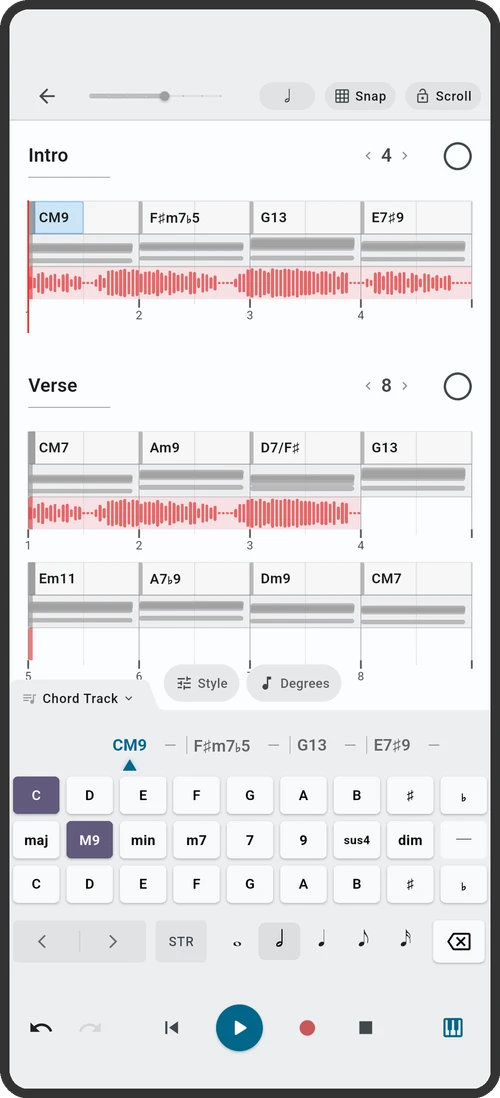
If your goal is writing songs — not reading notation — Faso lets you pick a key, choose chords that fit, and start recording immediately. You don't need to identify key signatures at sight. You just need to know which key you're in. The chords follow automatically.