The first thing every new musician runs into: what are all these dots on lines, and how do I know which one is which? It feels like decoding a secret language where everyone else got the key except you.
Here's the good news: there are only seven note names in all of Western music. The lines and spaces follow a simple, repeating pattern. Once you learn a handful of reference points — "anchor notes" — you can figure out any note on the page in under a second. This guide gives you the system, the memory tricks, and a practice routine that takes 10 minutes a day.
If you need the broader picture first — how the staff works, what clefs do, and where all this fits into reading music — check our complete beginner's guide to sheet music.
The Musical Alphabet (Yes, It Stops at G)
Music uses seven letters: A B C D E F G. After G, it starts over at A — the same note name, one octave higher. There is no H, no Z, no Q. This trips up almost everyone at first because we're so used to a 26-letter alphabet.
The critical skill: be able to recite the musical alphabet forwards and backwards without thinking.
- Forward: A – B – C – D – E – F – G – A – B – C – D – E – F – G
- Backward: G – F – E – D – C – B – A – G – F – E – D – C – B – A
Why backwards? Because when you're counting down from a known note to find an unknown one, you're going backwards through the alphabet. If you can only recite it forwards, you'll fumble every time a note sits below your reference point.
Middle C is the center of the musical universe — it sits between the treble and bass staves, one ledger line below the treble staff and one ledger line above the bass staff. On a piano, it's the C closest to the middle of the keyboard. Everything builds outward from here.
Treble Clef Notes: Every Line and Space
The treble clef (also called the G clef) is used for higher-pitched notes — piano right hand, guitar, violin, flute, and vocal melodies for higher voices.
Lines (bottom to top): E – G – B – D – F
Mnemonic: Every Good Boy Deserves Fudge.
Alternative versions: Every Good Boy Does Fine / Elephants Got Big Dirty Feet / Empty Garbage Before Dad Flips. Pick whichever sticks — the sillier it is, the better you'll remember it.
Spaces (bottom to top): F – A – C – E
This one spells FACE — no mnemonic needed. The four spaces in the treble clef literally spell the word "face" from bottom to top.
Pro tip: instead of using the full mnemonic every time, memorize one or two anchor notes (see below) and count up or down from them. For example, if you know the bottom line is E, then two lines up is B, and the top line is F. You don't need to recite the whole "Every Good Boy" sentence for every single note.
Bass Clef Notes: The Lower Register
The bass clef (F clef) covers lower pitches — piano left hand, bass guitar, cello, trombone, and bass vocals. Its two dots sit on either side of the fourth line, marking it as F.
Lines (bottom to top): G – B – D – F – A
Mnemonic: Good Boys Do Fine Always.
Alternatives: Good Bikes Don't Fall Apart / Great Big Dragons Fly Around.
Spaces (bottom to top): A – C – E – G
Mnemonic: All Cows Eat Grass.
Alternatives: All Cars Eat Gas / All Cops Eat Grapes. Again, whatever sticks.
The trap to avoid
Relying on mnemonics for every single note will keep you slow. Use them as training wheels, not a permanent crutch. The goal is to see the third space of the treble clef and instantly think "C" — not "F-A-C-E... third space from bottom... C." The anchor note method below is how you graduate from mnemonics to instant recognition.
Ledger Lines: Notes Beyond the Five Lines
The five-line staff only covers nine notes (five lines + four spaces). Instruments like the piano, violin, and flute regularly play well beyond this range. To reach those notes, we use ledger lines — short horizontal lines added above or below the staff that act as temporary extensions.
Ledger lines follow the same line-space-line-space alternation as the main staff. The key is keeping track of which line you're on when counting out past the staff.
The first bar is treble clef (starting on middle C). The second bar switches to bass clef (also starting on middle C). Same pitch, same ledger-line position — but in treble it's below the staff, in bass it's above.
Middle C sits on one ledger line below the treble staff (and one ledger line above the bass staff). This is the most important ledger-line note to memorize because it's the bridge between both clefs.
For treble clef ledger lines below the staff: Middle C (one ledger line down), then the space below that is B, then the next ledger line is A, then the space below that is G. Count backwards through the alphabet from middle C.
For bass clef ledger lines above the staff: Middle C (one ledger line up), then the space above that is D, then the next ledger line is E. Count forward through the alphabet from middle C.
Sharps, Flats, and Naturals: Altering the Notes
The seven letter names cover the white keys on a piano. The black keys are reached with accidentals — symbols that modify a note's pitch:
- Sharp (♯): raises the note by one semitone. C♯ is the black key immediately to the right of C.
- Flat (♭): lowers the note by one semitone. B♭ is the black key immediately to the left of B.
- Natural (♮): cancels a previous sharp or flat, returning the note to its "white key" pitch.
- Double sharp (𝄪) / double flat (𝄫): raise or lower by two semitones. Rare in beginner music — you can ignore these for now.
Accidentals from the key signature apply to the entire piece automatically — you don't need to think about them note by note once you know the key. A sharp or flat written directly next to a note (a "courtesy" or "temporary" accidental) overrides the key signature for that measure only.
For a deep dive into key signatures and how to identify them, read our step-by-step guide to reading key signatures.
The Anchor Note Method: A Faster Way to Read
Instead of reciting a mnemonic for every note you see, memorize a small set of anchor notes — instantly recognizable reference points. Then count up or down from the nearest anchor to find any note.
Treble clef anchors (memorize these five):
- Bottom line = E
- Second line = G (the clef curls around it — that's why it's the "G clef")
- Middle line = B
- Top line = F
- Middle C = one ledger line below the staff
Bass clef anchors (memorize these five):
- Bottom line = G
- Fourth line = F (the two dots sit on either side — that's why it's the "F clef")
- Top line = A
- Second space = C
- Middle C = one ledger line above the staff
How to use anchors: see a note on the third space of the treble clef. Your nearest anchor is the second line (G). Count up: G (line 2) → A (space 2) → B (line 3) → C (space 3). Answer: C. With practice, this counting becomes near-instant. Eventually, every position on the staff becomes its own anchor and you stop counting entirely.
Note Values: How Long Each Note Lasts
The note's appearance — whether the head is hollow or filled, whether it has a stem and flags — tells you how long to hold it.
| Symbol | Name | Duration (in 4/4) | Count |
|---|---|---|---|
| 𝅝 | Whole note | 4 beats | "1-2-3-4" |
| 𝅗𝅥 | Half note | 2 beats | "1-2" |
| 𝅘𝅥 | Quarter note | 1 beat | "1" |
| 𝅘𝅥𝅮 | Eighth note | ½ beat | "1-and" |
| 𝅘𝅥𝅯 | Sixteenth note | ¼ beat | "1-e-and-a" |
Rests are the silent version of each note value — a whole rest hangs from a line, a half rest sits on a line, and a quarter rest looks like a squiggly lightning bolt. Each rest tells you exactly how long not to play.
A dot after a note adds half its length. A dotted half note = 3 beats (2 + 1). A dotted quarter = 1.5 beats. Two eighth notes beamed together share a single horizontal bar instead of individual flags — it's the same duration, just cleaner to read.
A 10-Minute Daily Practice Routine
Consistency beats intensity. Ten minutes a day for two weeks will produce better results than two hours of cramming on a Saturday. Here's the routine:
- Minutes 0–2: Recite the musical alphabet forwards and backwards three times each. Say it out loud.
- Minutes 2–5: Flashcard drill — 20 random notes, treble clef only, name them as fast as you can. Use physical cards or an app like musictheory.net.
- Minutes 5–8: Same drill, bass clef. Aim for under 2 seconds per note.
- Minutes 8–10: Read one line of actual music — a beginner piano piece, a folk song melody, anything. Name every note out loud before you play it. Don't worry about rhythm during this part; focus only on note naming.
Three Struggles Every Beginner Faces (and How to Beat Them)
- "I keep mixing up the treble and bass clef notes." This is normal. The same position on both staves represents different notes — third space is C in treble clef but E in bass clef. The fix: practice one clef exclusively for a full week before introducing the other. Your brain needs time to build separate visual templates for each clef. Switching back and forth too early creates interference.
- "I can name the notes on flashcards but I freeze when looking at real music." Flashcards isolate one note at a time. Real music is a stream of notes in sequence. The fix: transition from flashcards to real sheet music as soon as you're above 80% accuracy. Read one bar at a time. Say the note names in rhythm — "C... E... G... C" in the actual tempo of the piece. This bridges the gap between recognition and reading.
- "I wrote in all the note names and now I can't stop relying on them." Writing note names above every note feels helpful in the moment but it trains your eyes to read the letters, not the staff. The fix: gradually erase them. Remove the labels from the easiest notes first (the ones you reliably recognize) and work up to the harder ones. Your goal is a completely clean page.
Beyond the Staff: What Comes Next
Once you can reliably name notes on both clefs — even if it takes a second — you're ready for the next layer: key signatures (which notes are automatically sharp or flat) and time signatures (how the rhythm is organized). Our key signature guide picks up right where this one leaves off.
And if there are specific notes or patterns that keep tripping you up — ledger lines, accidentals in fast passages, double sharps — our guide on the most difficult music notes to learn has targeted strategies for each of them.
Note reading is a skill, not a talent. Every musician who reads fluently today started exactly where you are — slowly naming notes, reciting mnemonics, counting ledger lines. The ones who stuck with the daily 10-minute routine are the ones who got fast. Be one of them.
Write songs, not notation
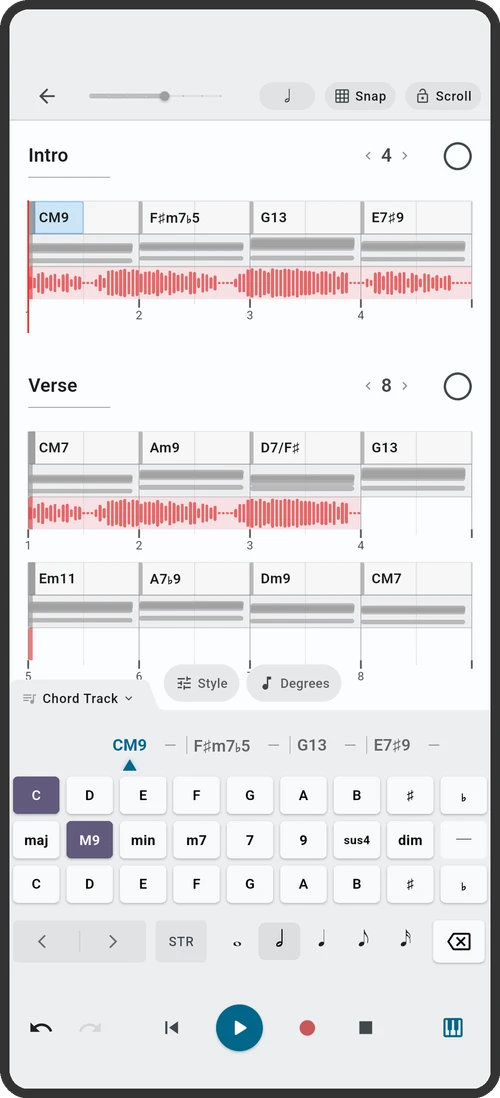
You don't need to read music to write songs. Faso lets you build songs from chord sheets — pick a progression, set your key, and record without touching a sheet of manuscript paper. Use note-reading as a reference tool, not a barrier.