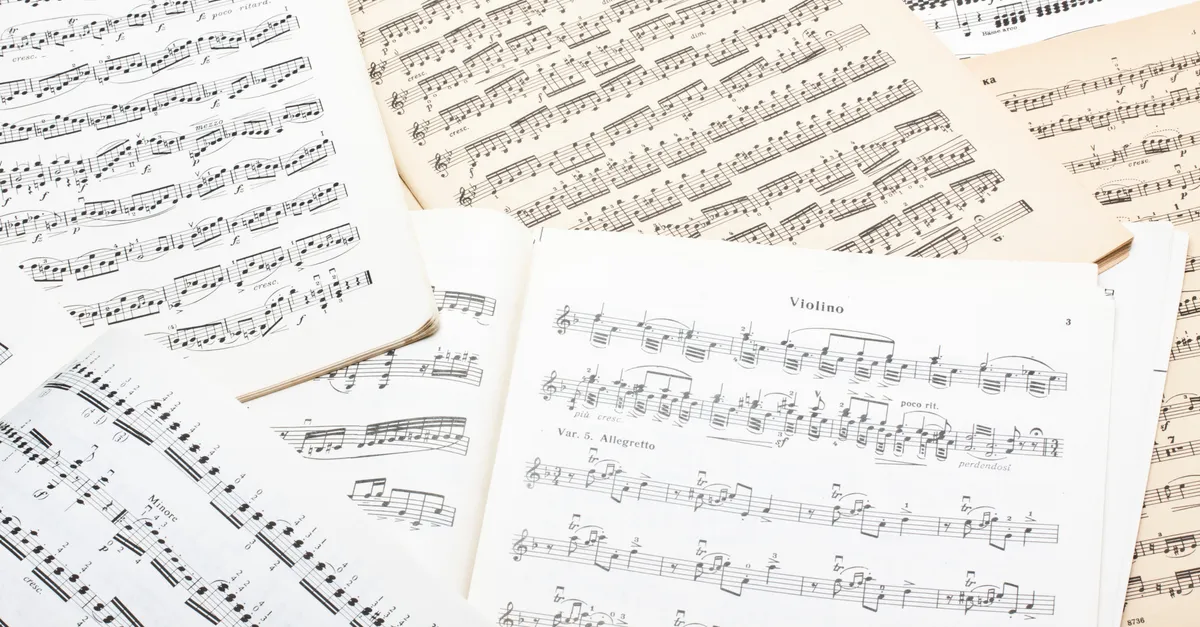
Sheet music looks like a foreign language. Dots on lines, curly symbols, clusters of # and b marks — if you've stared at a page of notation and thought "I have no idea where to even start," you're in exactly the right place.
Here's what most tutorials won't tell you upfront: you can learn the entire system in about two hours. The notation is logical and consistent — once you understand a handful of concepts, the whole thing unlocks. This guide walks you through them in the order you actually encounter them when you look at a piece of music, not in the order a textbook would arrange them.
We'll stay practical — no conservatory jargon, no assumptions about what you already know. If you want to go deeper on any topic, each section links to a dedicated guide that covers it in full. Let's start with the thing everyone wonders first.
What You're Actually Looking At When You See Sheet Music
Open any page of sheet music and you see the same three things, in this order, from left to right:
- A curly symbol at the far left — the clef. It defines which notes the lines represent. Most music uses treble clef (higher notes) or bass clef (lower notes). Piano music uses both in a grand staff — treble on top for the right hand, bass below for the left.
- A cluster of # or b marks next to it — the key signature. It tells you which notes are permanently raised or lowered. Basically, it sets the "color palette" for the whole piece. No sharps or flats = C major.
- Two stacked numbers — the time signature. It defines the beat: how many beats per measure, and what kind of note counts as one beat. 4/4 (four quarter notes per bar) is by far the most common.
Everything else — the notes, the rests, the dynamics markings — sits on a five-line grid called the staff. Higher on the staff = higher pitch. Notes that sit above or below the five lines sit on short extensions called ledger lines. Vertical lines called barlines divide the staff into measures, each containing the number of beats the time signature specifies.
That's the container. A page of sheet music is clef + key signature + time signature, repeated across staves. Once you know how to read those three things, you know what you're looking at. Here's what all three elements look like together on a real staff:
Treble clef on the left, no sharps or flats (= C major), 4/4 time, and four bars of notes. The note positions on the staff tell you which pitch to play. The next question: how do you know which note is which just by looking at its position?
How to Know Which Note to Play (Pitch)
Music uses seven letter names — A, B, C, D, E, F, G — that repeat with each octave. Where a note sits on the staff tells you which letter to play. The clef determines the mapping:
- Treble clef lines (bottom to top): E–G–B–D–F — "Every Good Boy Deserves Fudge"
- Treble clef spaces (bottom to top): F–A–C–E — spells "FACE"
- Bass clef lines (bottom to top): G–B–D–F–A — "Good Boys Do Fine Always"
- Bass clef spaces (bottom to top): A–C–E–G — "All Cows Eat Grass"
Mnemonics are your training wheels — use them. But the real goal is to graduate to anchor notes: memorizing a few key positions and counting up or down from them. With a 10-minute daily routine, most people build reliable note-naming speed in about two weeks. Our dedicated guide covers the complete system:
How Long to Hold Each Note (Rhythm)
The shape of a note — whether its head is hollow or filled, whether it has a stem and flags — tells you how long to hold it:
- A hollow note head with no stem (whole note) = 4 beats
- A hollow head with a stem (half note) = 2 beats
- A filled head with a stem (quarter note) = 1 beat
- Add a flag (eighth note) = half a beat. Two flags (sixteenth) = a quarter beat
Rests are the silent counterpart — each note duration has a matching rest symbol. A dot after a note adds half its value (a dotted half = 3 beats). A tie connects two notes of the same pitch into one continuous sound.
Same note (middle C), four different durations. Notice how the note head stays the same but the stem length and flags change the rhythmic value.
You don't need to memorize this table on day one. The important thing is the pattern: filled notes are shorter than hollow ones, and every added flag divides the duration in half. For the full reference table and a rhythm-reading practice routine:
See the complete Note Values table & practice routine →
Sharps, Flats, and the Key of the Song
A sharp (♯) raises a note by one semitone — the black key to the right on a piano. A flat (♭) lowers it — the black key to the left. When these symbols appear in the key signature at the start of a piece, they apply to every occurrence of that note, automatically, throughout the entire song.
Identifying which key you're in from the signature is a two-rule skill:
- For sharps: look at the last sharp, go up one semitone. Two sharps (F♯, C♯) → last is C♯, up one → D major.
- For flats: look at the second-to-last flat. Three flats (B♭, E♭, A♭) → second-to-last is E♭ → E♭ major.
- No sharps or flats: C major (or A minor).
There are 15 possible key signatures in total, organized neatly by the circle of fifths — a visual map that shows how keys relate to each other. Each major key has a relative minor (same signature, different emotional feel). Rather than cramming all 15 here, we have a dedicated walkthrough:
Time Signatures: The Beat Behind the Bars
The time signature is the two stacked numbers after the key signature. The top number is how many beats per measure. The bottom number is what kind of note counts as one beat (4 = quarter note, 8 = eighth note). Most popular music is in 4/4: four beats per bar, quarter note gets the beat. You count "1-2-3-4, 1-2-3-4."
Other common signatures: 3/4 (waltz — "oom-pah-pah"), 6/8 (rolling triplet feel — think "We Are the Champions"), and 2/4 (brisk march). Tap your foot to the beat while reading — it anchors everything. The time signature is your rhythmic grid; the notes and rests fit inside it. Here's the difference between the two most common ones:
First two bars are 4/4: four beats each, steady pulse. Last two bars switch to 3/4: three beats per bar, the "oom-pah-pah" waltz feel. Same notes, different time signature = completely different groove.
How to Read Your First Piece From Start to Finish
You now have the full toolkit. Here's the checklist for reading any piece of sheet music from scratch:
- Check the clef. Treble or bass? This determines your note-name reference.
- Check the key signature. Which notes are permanently sharp or flat? This tells you the key and which seven notes belong.
- Check the time signature. How many beats per measure? This is your counting pulse.
- Scan for accidentals and dynamics. Any temporary sharps or flats? Any loud (f) or soft (p) markings?
- Find the starting note. Name the first note and its duration. Find it on your instrument.
- Go slow, one measure at a time. Accuracy first. Speed comes from repetition.
Pick something simple — "Twinkle Twinkle Little Star," "Ode to Joy," or a beginner piano book piece. The goal isn't to impress anyone. It's to prove to yourself that the system works. Because once you read your first piece, you know you can read the next one.
Running into notes or patterns that keep tripping you up? Ledger line overload, double sharps, remote keys with five or six accidentals — our guide to the most difficult music notes to learn has targeted strategies for each one.
Do You Actually Need to Learn Notation to Write Songs?
Honest answer: no. Some of the most successful songwriters in history — Paul McCartney, Jimi Hendrix, Hans Zimmer — compose primarily by ear. Most contemporary songwriters work from chord charts, lyric sheets, and reference recordings, not fully notated scores.
A chord-first workflow — pick a key, choose a progression, build melody and lyrics on top — sidesteps the notation bottleneck entirely. This is how the majority of pop, rock, country, and hip-hop songs are written. You don't need to know where F♯ sits on the treble clef to write a great song in the key of D.
That said, understanding notation fundamentals gives you an edge: you can communicate with other musicians more precisely, analyze songs you admire to understand why they work, and access centuries of written music. The practical path: learn enough notation to be dangerous — clefs, note names, rhythm, key signatures — and then focus your creative energy on making music.
Write songs, not notation
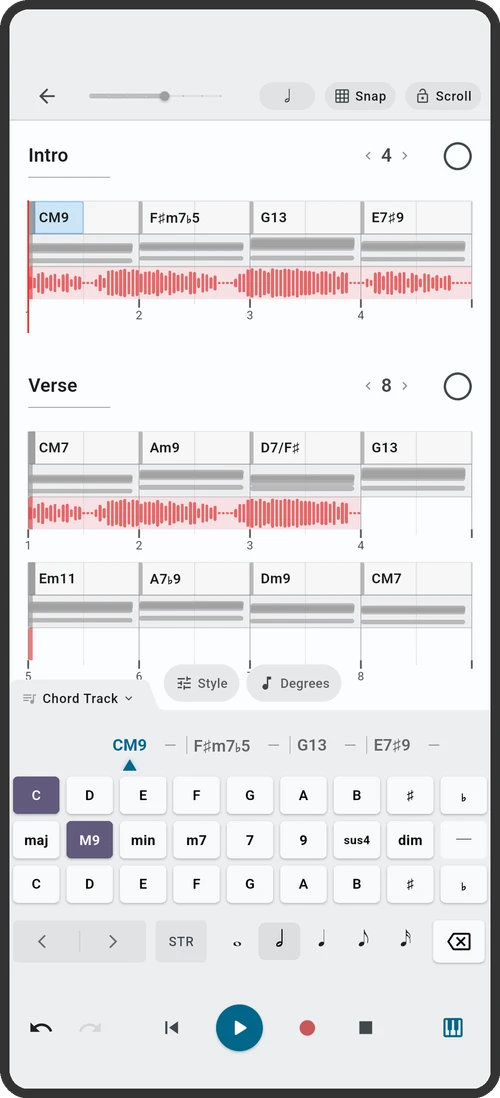
You don't need to read notation to write songs. Faso lets you start from chords, record vocals and layers, and build full arrangements — use notation as a reference tool, not a prerequisite.
Quick-Reference Cheat Sheet
- Musical alphabet: A B C D E F G (then repeats — no H)
- Treble lines (bottom→top): E G B D F — Every Good Boy Deserves Fudge
- Treble spaces (bottom→top): F A C E — spells FACE
- Bass lines (bottom→top): G B D F A — Good Boys Do Fine Always
- Bass spaces (bottom→top): A C E G — All Cows Eat Grass
- Sharp key shortcut: last sharp + one semitone = key name
- Flat key shortcut: second-to-last flat = key name
- No sharps or flats: C major or A minor
- Note durations (4/4): whole = 4 beats, half = 2, quarter = 1, eighth = ½, sixteenth = ¼
- Reading order: clef → key signature → time signature → notes → dynamics
You now know more about reading sheet music than most people who say "I wish I could read music." The gap between "I can't read music" and "I can read music" isn't years of study — it's about two hours of focused practice with the concepts above. Pick up a piece of simple sheet music, work through the checklist, and surprise yourself.