Not all music notes are created equal. A middle C on the treble clef — one ledger line, dead center — is easy. Anyone can learn to spot it in minutes. But then you encounter a note sitting on four ledger lines above the treble staff, or a double flat in a key with six sharps, and suddenly the whole system feels broken.
If you've hit a wall with certain notes — the ones that make you squint, count on your fingers, and still guess wrong — this guide is for you. We'll walk through the seven most common notation challenges, why each one is difficult, and the specific strategy that makes it manageable. These are the notes that separate casual readers from fluent ones. Let's tackle them one at a time.
New to reading music? Start with our complete beginner's guide to sheet music before diving into the harder stuff here.
Why Some Notes Are Genuinely Harder to Read
Music notation evolved over centuries, shaped by printing-press limitations, publishing economics, and academic tradition. It was not designed for ease of learning — it was designed to fit on a page and be reproducible with 18th-century technology. Some of the hardest things to read exist not because they're musically necessary, but because no one ever changed the convention.
The good news: you don't need to fight the entire system at once. Most "difficult" notation falls into a handful of categories, and each category has a specific fix. The key is isolating the problem — which specific type of notation is throwing you off — and drilling that one thing until it stops being scary.
Ledger Line Overload: When Notes Float Too Far From the Staff
The five-line staff covers nine note positions. Everything beyond that needs ledger lines — and the further you go, the harder it gets to tell at a glance which line is which. A note sitting on the fifth ledger line above the treble clef requires counting up ten positions from the top line of the staff. That's slow, error-prone, and exhausting.
Why it's hard: ledger lines are identical short dashes stacked above or below the staff. Your eyes can't easily distinguish "this note is on the third ledger line" from "this note is on the fourth ledger line" without counting — and counting breaks your reading flow.
How to master it:
- Memorize two "far anchor" notes. For treble clef: the note two ledger lines above the staff is C (two octaves above middle C). For bass clef: the note two ledger lines below the staff is C. These give you a distant reference point so you're never counting more than 2–3 positions from a known note.
- Recognize intervals, not individual notes. Instead of naming every ledger-line note individually, read the distance between consecutive notes. If you know the first note of a phrase is high C, and the next note is a third above it, you don't need to name it — you just play a third above.
- Consider 8va notation. If you're transcribing or arranging, use the 8va symbol (ottava alta) — it shifts the notes one octave down on the staff while preserving the intended pitch. This eliminates most extreme ledger lines entirely. Professional sheet music uses 8va regularly for exactly this reason.
Look at the last two notes: that's B on the fourth ledger line, and high C on the fifth. Counting that many ledger lines mid-performance is a real bottleneck. Use anchor notes.
Strange Accidentals: F♭, C♭, Double Sharps, and Double Flats
An F♭ sounds exactly like an E. A C♭ sounds exactly like a B. A double sharp (×) on F raises it to G. So why aren't they just written as E, B, and G? Because of spelling rules — in certain keys, the correct spelling of a note requires these "enharmonic" spellings. A G♭ major chord, for example, must be spelled G♭ – B♭ – D♭. Writing it as G♭ – A♯ – D♭ would be musically wrong, even though A♯ and B♭ are the same piano key.
Why it's hard: your brain has to translate on the fly — "F♭ means play E, C♭ means play B." It's a mental extra step that disrupts reading flow. Double sharps and double flats are even worse because they're rare enough that most intermediate players have never practiced them.
How to master it:
- Know the keys where they appear. F♭ appears in C♭ major and G♭ major. C♭ appears in G♭ major and D♭ major. Double sharps appear in keys with 5+ sharps (B major, F♯ major, C♯ major). Double flats appear in keys with 5+ flats. If you know you're in one of these keys, brace yourself for strange spellings.
- Remap mentally to the natural note. When you see F♭, think "E." When you see B♯, think "C." When you see a double sharp, think "two semitones up — which is a whole step." With enough exposure, this translation becomes automatic.
- Don't avoid music that uses them. The only reason these notations stay scary is that most students skip the pieces that contain them. Play through a few pieces in F♯ major or D♭ major and the strangeness wears off.
Remote Key Signatures: 5, 6, or 7 Sharps and Flats
C major (no sharps or flats) is everyone's comfort zone. Add one or two sharps and it's still manageable. But when you hit B major (5 sharps), F♯ major (6 sharps), or C♯ major (7 sharps), the notation looks aggressive — almost every note carries a sharp. The same applies to the flat side with D♭ major (5 flats) and G♭ major (6 flats).
Why it's hard: the sheer number of accidentals creates visual noise. Your eyes scan the page and see sharps everywhere. Plus, some of those sharps are E♯ (which is F) and B♯ (which is C) — notes that exist on "white keys" but are spelled with sharps. It's a cognitive mismatch.
How to master it:
- Accept the key and stop translating. In F♯ major, every F, C, G, D, A, and E is sharp. Don't think "F but sharp" — think "in this key, that line is F♯, period." The staff position is F♯; there's no separate F to compare it to.
- Practice scales and arpeggios in remote keys. The fastest way to internalize a key signature is to play the scale repeatedly. Your fingers learn which notes are sharp or flat without your brain needing to check. After twenty repetitions of the F♯ major scale, seeing six sharps at the start of a piece feels normal, not threatening.
- Use the circle of fifths as a reference, not a crutch. See our key signature guide for a full breakdown of every key and how to identify them instantly.
Six sharps looks intimidating, but once you accept the key and stop translating each accidental, it's the same major scale pattern your fingers already know.
Mixed Sharps and Flats in the Same Passage
Most music stays in one key and uses only sharps or only flats. But some composers — particularly in the late Romantic era and in modern classical — mix sharps and flats within a single phrase. An F♯ might be followed immediately by a D♭. This is like reading a sentence that switches between English and French in every other word.
Why it's hard: your brain sets up an expectation based on the key signature (say, three sharps → A major). When flats start appearing mid-phrase as accidentals, it violates the pattern and forces you to override your automatic processing. Every note becomes a conscious decision instead of a reflex.
How to master it:
- Slow down drastically. This is not sight-reading material. Treat mixed-accidental passages like a puzzle — figure out each note deliberately, then build up speed once your fingers know the pattern.
- Look for chromatic lines. Mixed sharps and flats usually mean a chromatic passage — notes moving by semitone in one direction. If you spot a rising chromatic line (C – C♯ – D – D♯ – E), the mixed accidentals become predictable. You stop being surprised by each accidental because you understand the musical logic behind it.
- Mark your part. In complex passages, there's no shame in circling accidentals or writing in reminder naturals. Professional musicians do this regularly in orchestral parts. The goal is accurate performance, not a test of memory.
Complex Rhythms: Ties, Syncopation, and Tuplets
Rhythm is at least half of what makes music work, but most beginners spend 90% of their practice time on pitch and 10% on rhythm. Then they hit a passage with tied notes across barlines, syncopated off-beat accents, or triplet figures nested inside duple meter — and everything falls apart.
Why it's hard: rhythm notation is abstract. A dot, a tie, or a flag doesn't make a sound until you translate it into timing. And complex rhythms often involve multiple simultaneous layers (e.g., a dotted eighth + sixteenth pattern in one hand against straight quarters in the other), which requires coordination as well as reading.
How to master it:
- Count out loud, always. Literally say "one-and-two-and-three-and- four-and" while you play. If you can't count it out loud, you don't truly understand the rhythm.
- Clap it first, play it second. Before touching your instrument, clap or tap the rhythm of the passage. This isolates the timing from the pitches. Once the rhythm is in your body, adding the notes back is much easier.
- Subdivide to the smallest note value present. If the passage contains sixteenth notes, count every bar as "1-e-and-a 2-e-and-a..." even for the longer notes. This keeps your internal pulse steady and prevents rushing through simpler bars.
- Use a metronome — but slowly. Set the metronome to half the written tempo and focus on precision. Speed comes after accuracy, never before.
Reading Multiple Notes at Once (Chords on a Staff)
Single-line melodies are one thing. But when you see three, four, or five notes stacked vertically on the same stem — a chord — your brain has to process all of them simultaneously. Piano music, in particular, does this constantly across both staves.
Why it's hard: you can't name notes one at a time when there are four of them. By the time you've identified the bottom note of a chord, the music has moved on. Stacked notes require a fundamentally different reading strategy than linear melodies.
How to master it:
- Read bottom-up and top-down simultaneously. Name the bottom note and the top note first. The middle notes are almost always the interval between them filled in — if the bottom is C and the top is G (a fifth), the middle notes are probably E and maybe another G or C. You're reading the shape of the chord, not every individual note.
- Recognize chord shapes, not individual notes. A stack of three notes on adjacent lines or adjacent spaces is a root-position triad. A stack with one line skipped in the middle is an inversion. Learn to see these shapes at a glance. After enough exposure, you'll recognize a C major triad on the treble clef the same way you recognize a word on a page — as a single visual unit, not as individual letters.
Clef Changes Mid-Piece
Some instruments — particularly viola, cello, and bassoon — regularly switch clefs within the same piece. A cello part might start in bass clef, switch to tenor clef for a high passage, then return to bass clef. The same staff position that was a C two bars ago is now an A.
Why it's hard: your visual-to-note mapping, which you've spent weeks or months building, suddenly becomes wrong. The third space isn't C anymore. Your muscle memory rebels.
How to master it:
- If you're a pianist or guitarist, this probably doesn't apply to you. Piano and guitar music use treble and bass clefs exclusively and never change clefs mid-piece. Don't spend time on a problem you won't encounter.
- For cellists and violists: learn tenor and alto clefs by relating them to what you already know. The note one ledger line below the treble staff is middle C — that same note is the second line from the top in alto clef. Find one or two "bridge notes" that map between the clefs and orient from there.
- Practice clef-switching exercises. Read a simple tune in bass clef, then immediately read the same tune transcribed into tenor clef. The direct comparison builds the mental mapping faster than isolated practice.
A Practice Strategy for Difficult Notation
When you encounter a passage with notation that's over your head, don't just push through it at full tempo and hope for the best. That's how mistakes become habits. Use this instead:
- Isolate the problem. Which specific thing is hard? Ledger lines? Accidentals? Rhythm? Don't treat "this passage is hard" as one problem. Name the exact difficulty.
- Remove one layer. If the rhythm is tripping you up, ignore the pitches — clap the rhythm only. If the pitches are the problem, ignore the rhythm — name every note out loud at your own pace. Solve one dimension at a time.
- Slow down until it's easy. If you can't play it correctly at half tempo, go to quarter tempo. There is no tempo too slow for learning. The goal is correct repetition, not impressive speed.
- Loop the hard bar in isolation. Don't keep starting from the beginning of the piece. Play the difficult bar (or even just the difficult beat) five times correctly in a row before connecting it to the bars around it.
- Come back tomorrow. Sleep consolidates motor learning. A hard passage practiced for 10 minutes today and 10 minutes tomorrow will be more secure than one practiced for 30 minutes straight today. Your brain needs the consolidation window.
What Actually Matters for Most Musicians
Unless you're aiming to become a professional orchestral musician or a session sight-reader, you don't need to read every type of complex notation fluently. Most songwriters, producers, and contemporary musicians live in a world of chord charts, lead sheets, and DAW piano rolls — none of which require grappling with double flats or tenor clef changes.
The goal isn't to master every obscure notation convention. It's to be comfortable enough that notation stops being a barrier — so you can look at a piece of sheet music, understand what's happening, and use it as a tool rather than feeling locked out.
Focus your energy on the challenges that show up in the music you actually want to play. For most people, that means: treble and bass clef fluency, ledger lines up to 2–3 lines, key signatures up to 4 sharps/flats, and basic syncopation. Master those, and you've covered 95% of what you'll encounter.
For the fundamentals that make everything else easier, revisit our music notes for beginners guide or the full sheet music reading guide.
Write songs, not notation
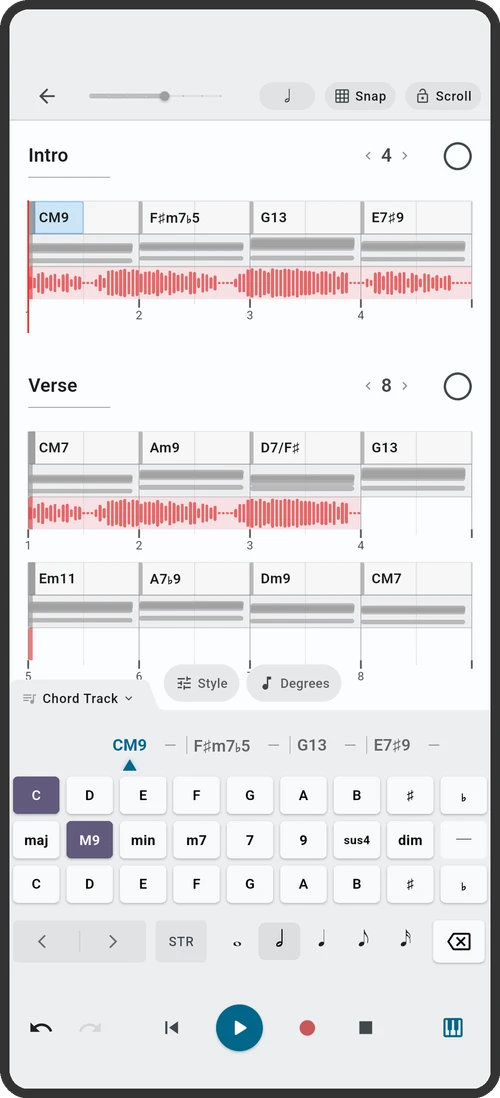
Most songwriters and producers don't sight-read notation — they work from chord charts, piano rolls, and reference recordings. Faso gives you the chord-first workflow: pick your key, build your progression, and record. The song comes first.